

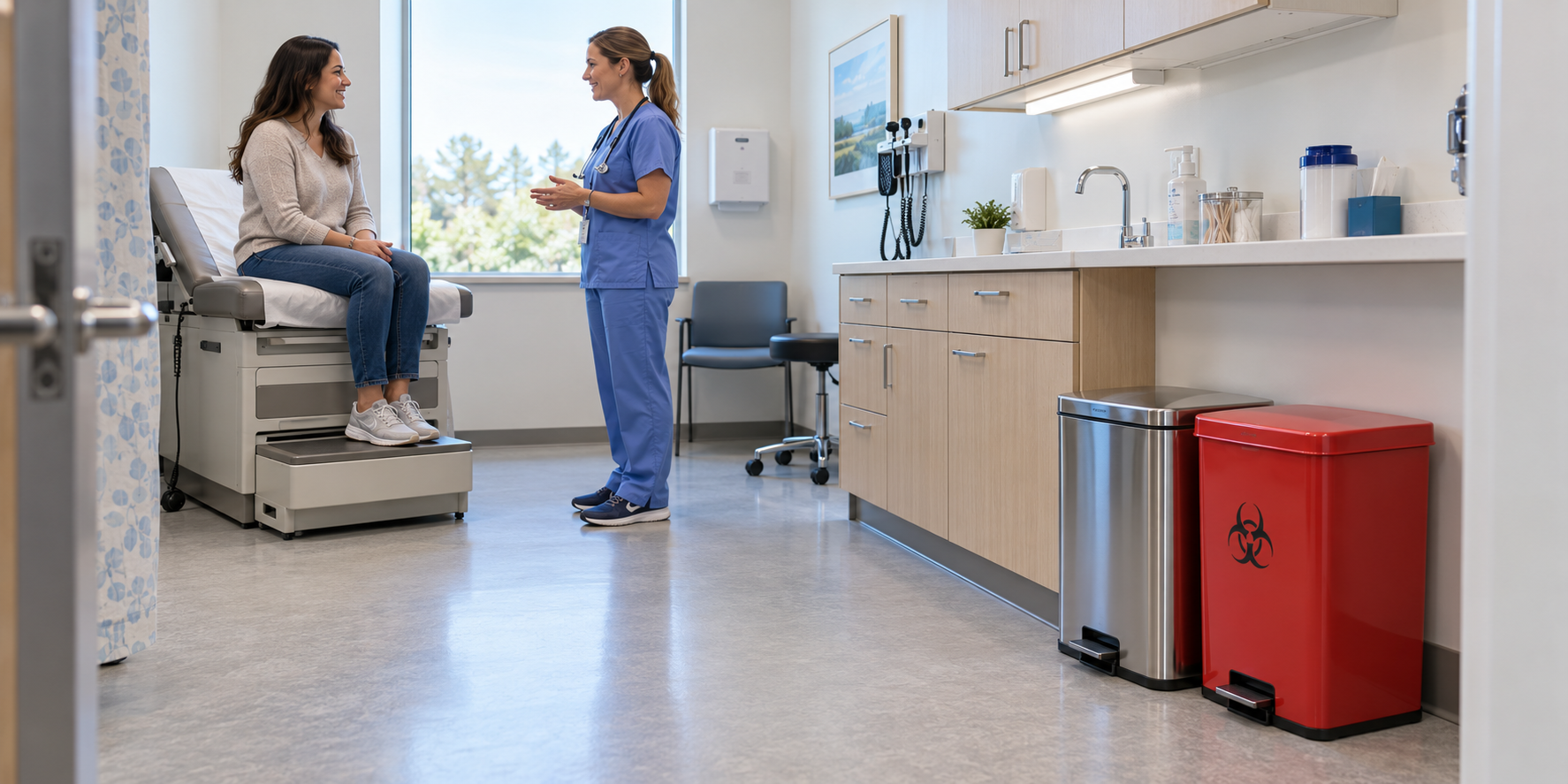
Choosing a waste receptacle should be easy. Pick a size, choose a lid, and move on to the next item on the equipment list. There are certainly more exciting things to shop for.
But healthcare has a way of making even the humble trash can less than a simple purchase.
What goes inside determines the type of container you need.
Where it sits affects its size and design.
And the people using, cleaning, and emptying it may have very different ideas about what makes it a good choice.
Getting those details right takes a little coordination. The good news? You can work through them in a sensible order without turning a trash can purchase into a six-month committee assignment.
This healthcare waste receptacles buying guide suggests four connected steps to consider before purchasing waste receptacles.
- Identify the waste to establish the appropriate container category.
- Define the collection needs to determine capacity and placement.
- Choose a design that fits daily use, cleaning, and emptying.
- Evaluate total cost of ownership before committing to the purchase.
Let’s get started.
Step 1: Identify the Waste Before Selecting the Receptacle
Start with what will go into the container.
General trash, recycling, regulated medical waste, and contaminated sharps have different collection requirements. At the risk of stating the obvious, a receptacle suitable for one category may be inappropriate for another.
Best Practice: Review the waste generated in each intended location with infection prevention, environmental services, and the person responsible for the facility’s waste program. Include pharmacy or environmental health and safety when specialized waste is involved.
Here is a top-level table showing common waste categories and the questions to answer as you map the waste receptacles in your facility to a category.
|
Waste category |
What the buying team should establish |
|
General trash |
Which materials belong in ordinary trash under facility policy |
|
Recycling |
Which materials the recycling program accepts and how they should be separated |
|
Regulated medical waste |
Applicable containment, closure, and identification requirements |
|
Contaminated sharps |
Required sharps-container construction and point-of-use placement |
|
Pharmaceutical or other hazardous waste |
The collection system appropriate to the specific waste classification |
Turn the Classification Into Purchasing Requirements
Once the waste is classified, identify the regulations that govern the required features for each category of waste container.
For example, OSHA’s Bloodborne Pathogens Standard requires regulated waste containers to be closable, prevent fluid leakage during handling and transport, carry the required labeling or color coding, and close before removal.
Contaminated sharps containers must also be puncture resistant and leakproof on the sides and bottom. www.osha.gov
Best Practice: Look beyond the required labeling or color coding to confirm that the container also meets the construction and closure requirements for its intended waste stream. Ask the manufacturer for documentation, including specifications for any required liner or inner container.
Medical waste is primarily regulated by state environmental and health agencies, with additional federal requirements applying. Confirm the rules for your location rather than assuming a container approved for another facility will meet your needs. Hazardous waste pharmaceuticals require a separate review under the applicable EPA requirements. www.epa.gov
Following regulatory standards will establish the nonnegotiable waste receptacle features. Up next, determine how much waste the container must hold and where collection will happen.
Step 2: Define Capacity and Placement Around the Collection Routine
The right capacity depends on the waste generated between scheduled collections. Basing capacity criteria on room use alone is not always the best decision.
Review waste volume during busy periods, the bulk of discarded materials, and the collection schedule. Lightweight packaging can fill a container quickly without adding much weight. Other waste may create a heavy bag before the receptacle looks full.
Keep in mind that a larger container is useful only if the filled liner remains manageable and the collection schedule stays consistent with facility policy. Buying more capacity should not quietly become a plan to empty containers less often.
Confirm the Space the Container Will Actually Use
With a capacity range established, measure the intended location. Include the space required for the lid to open, the pedal to operate, and the bag to be lifted out in the final footprint dimensions.
Consider nearby doors, drawers, carts, and examination equipment. A container that fits beneath a counter when closed may be unusable when someone tries to open it.
Slim designs can help in tight spaces, but a narrow opening may also make bulky waste difficult to discard.
Sharps-container placement requires particular attention. OSHA requires contaminated sharps containers to be easily accessible, positioned as close as feasible to where sharps are used, maintained upright, and replaced before overfilling. www.osha.gov
Wall mounting may be worth considering where floor space is limited. Confirm mounting requirements, user reach, and replacement access before choosing that configuration.
At this point, the purchasing specification should be able to identify the waste category, capacity range, location, and operating clearance. Establishing these details makes it easier to evaluate the features that staff will interact with every day.
Step 3: Choose a Waste Container Based on Workflow
Now consider the workflow of the area where the container is located: someone discards waste, someone cleans the receptacle, and someone empties or replaces it.
Start With Disposal Access
Choose a lid mechanism that fits the task and the location.
Step-on models offer hands-free opening without batteries. Test pedal accessibility, operating force, and stability on the flooring where the container will sit. A bin that slides away during use adds choreography nobody requested.
Sensor models also offer hands-free operation, but introduce batteries and electronic components. Check activation range, opening speed, and low-power behavior. Nearby movement should not repeatedly trigger the lid.
Manual, swing-lid, and open-top designs may suit environments where the waste stream and facility requirements permit them. Consider whether the opening requires hand contact or pushing waste against a surface.
In patient care areas, lid noise may also influence the container choice. Test soft-closing mechanisms rather than relying on the feature name.
Then Review Cleaning Compatibility in Relation to Disposal Access
The same lid assembly that works well during disposal also needs to tolerate required cleaning protocols.
Ask the manufacturer whether the body, finish, hinges, pedal, and electronic components are compatible with the facility’s preferred cleaning products. CDC guidance calls for following disinfectant manufacturers’ instructions, including contact time and material compatibility. cdc.gov
Plastic and metal receptacles both deserve a product-specific review. Neither material name tells you how every finish or component will perform.
Other best practices:
Look for accessible interior surfaces and components that can be removed and reinstalled without unnecessary effort.
Inspect seams, recessed hinges, and bag-retention hardware. These details are easy to miss in a catalog photo and hard to ignore during cleaning.
Finish by Evaluating Emptying and Relining
Environmental services should be involved with evaluating this part of the process before a purchase order is finalized.
Using a demo, if available, install the intended liner, confirm that it stays secure, and review how staff release and remove it. Look for snag points, awkward lifting, and hardware that becomes difficult to reach when the bag is full.
Do not assume matching gallon capacities guarantee a fit. Liner width, length, and strength matter as much as the container’s shape and retention system.
Review of workflow should leave the team with a short list of waste containers that meet the required specifications and perform consistently through the full collection cycle.
Step 4: Evaluate the Full Cost of Ownership
While aligning staff, environmental services, and facilities on the best waste containers for your facility is a primary consideration, comparing total cost of ownership runs a close second.
Once you’ve identified waste containers that meet your facility’s requirements, compare what each option will cost to purchase, use, and maintain.
Estimated ownership cost = purchase and delivery + consumables + maintenance and replacement parts + cleaning and collection labor.
Evaluate each option over the same period and under the same workload assumptions. Include compatible liners, batteries where applicable, and replacement parts. Review warranty coverage to understand which repair or replacement expenses your facility would be responsible for.
Consider how often staff will need to empty and clean each container. Count potential labor savings only when you can tie them to a measurable difference in those tasks.
Also confirm whether lids, pedals, inner buckets, or other serviceable components can be replaced individually. A worn part should not automatically turn the entire receptacle into its own waste stream.
It goes without saying that a lower purchase price may offer little savings if the container requires more expensive liners or frequent repairs.
Thorough cost comparison can also help create an approved container selection for standardization of waste receptacles by use category.
Standardize Healthcare Waste Containers by Use Category
After comparing costs, establish an approved selection of waste containers for your facility. Standardization works best when it groups containers by waste stream and room requirements. One model is unlikely to suit every location.
Start with areas that share similar needs. Exam rooms may use the same container model and liner size, while procedure rooms may require a different capacity or opening mechanism. Keep exceptions where space, waste volume, or disposal requirements call for another option.
For each approved model, document:
- Intended waste stream and locations
- Container size and capacity
- Compatible liners and replacement parts
- Manufacturer’s cleaning instructions
- Any location-specific requirements
Best Practice: Keep this information accessible to purchasing, environmental services, and department staff.
An established specification gives teams a consistent reference when ordering replacements or equipping new rooms.
Partner with CME Corp. for Waste Receptacles
Working through waste classification, collection needs, product design, and purchase validation gives your team a clearer starting point for sourcing. CME can help compare waste receptacle options, review product specifications, and coordinate purchasing for individual replacements or larger facility projects.
Shop CME for waste receptacles or connect with your CME account manager to discuss your requirements. Prefer to start with a quick question? Click CHAT.
Frequently Asked Questions
Can healthcare facilities use commercial trash cans for general waste?
Yes, commercial trash cans may be suitable for waste classified as ordinary trash, provided they meet facility policies and applicable requirements for the location. Being in a healthcare setting does not automatically make every discarded item regulated medical waste. Confirm the classification with your waste management team before choosing the container.
Are reusable or disposable sharps containers the better choice?
Neither is the automatic winner. Compare the complete collection program, including replacement frequency, storage needs, service availability, and cost. Reusable systems require arrangements for safe collection, emptying, and processing. OSHA permits reusable sharps containers but prohibits opening, emptying, or cleaning them manually or in another way that exposes employees to puncture injuries. Ask prospective vendors to explain how their system manages that process.
Can a waste collection receptacle also be used for off-site transport?
Sometimes, but suitability for room collection does not automatically qualify a container for shipping. Regulated medical waste transportation has packaging requirements that depend on the waste and shipping arrangement. Before buying a container for both purposes, confirm its intended use with the manufacturer and have your waste contractor verify the required packaging, closure, and labeling. A secure lid is only part of the picture.
Does an antimicrobial finish replace routine cleaning?
No. An antimicrobial finish does not give a waste receptacle a pass on cleaning day. Some treatments protect only the product itself from odor-causing bacteria or deterioration, rather than protecting people from infection. Review the manufacturer’s specific claims and follow your facility’s established cleaning and disinfection procedures.
Can clean medical supply packaging go in recycling bins?
Some can, but check with your facility’s recycling contractor before adding it to the bin. Acceptance depends on the material and the collection program. A recycling symbol or plastic resin number does not guarantee acceptance. Once you have a confirmed list, label bins with the specific packaging staff can recycle so they do not have to guess during a busy shift.
About CME: CME Corp is the nation’s premier specialty distributor of healthcare, laboratory, and imaging equipment. We partner with over 2,000 manufacturers to offer more than 2 million products. In addition to an extensive product portfolio, we also offer project management, CAD-based layout, design and 3d modeling, warehousing, assembly, staging, consolidated, need-by-date direct-to-site delivery, and biomedical and technical services, all staffed by CME employees. Our mission, to help healthcare facilities nationwide reduce the cost of the equipment they purchase, make their equipment acquisition, delivery, installation, and maintenance processes more efficient, and help them seamlessly launch, renovate, or expand on schedule, is supported by service locations strategically located across the country.