

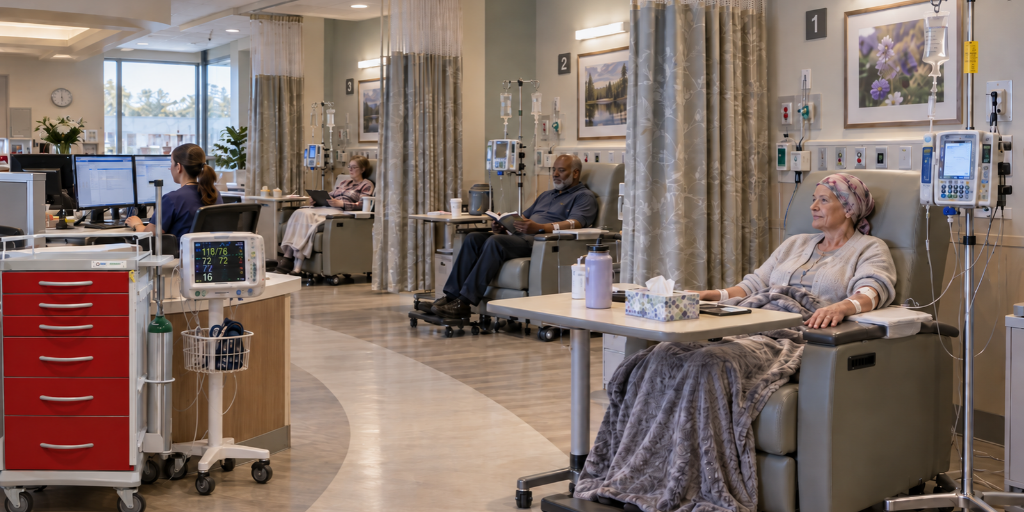
Outpatient infusion centers serve patients receiving everything from routine hydration and iron infusions to complex biologic therapies and oncology treatments. While the therapies may differ, each center depends on a combination of medical equipment, patient furnishings, and clinical infrastructure to operate effectively.
Selecting that equipment involves more than determining how many infusion chairs and pumps to purchase. Treatment duration, medication requirements, patient mobility, nursing workflow, and available space all influence what belongs on the equipment list.
So, what equipment should an outpatient infusion center have, and what should healthcare teams consider before making purchasing decisions?
From infusion recliners and IV pumps to patient monitoring devices, emergency equipment, and medication storage, the purchasing list covers several distinct categories.
This guide examines the equipment used in outpatient infusion centers and the practical considerations involved in evaluating options for a new facility, expansion, or equipment update.
Before we take a look at specific equipment, it's worth looking at what determines which equipment belongs on the purchasing list in the first place. The therapies offered and the patients receiving them are a good starting point.
Start with the Treatments Your Infusion Center Will Offer
Before developing an equipment list, identify the center's clinical scope.
Outpatient infusion centers may administer:
- Chemotherapy and other oncology treatments
- Biologic therapies for autoimmune and inflammatory conditions
- Intravenous immunoglobulin (IVIG)
- Iron replacement therapy
- Antibiotic infusions
- Hydration and electrolyte replacement
- Other specialty intravenous medications
Treatment types affect equipment requirements, but they also influence how frequently equipment is used and how long treatment spaces remain occupied.
For example, a center treating patients who receive lengthy infusions may prioritize adjustable recliners and flexible positioning. A facility administering shorter treatments may place greater emphasis on the number of available treatment stations and the ability to prepare each station for its next patient.
Patient volumes and staffing models deserve consideration as well. An eight-chair center operating primarily on scheduled appointments may have different equipment demands than a larger center managing overlapping treatment schedules.
The objective is to build an equipment list around the clinical services and expected activity of the center rather than selecting equipment solely by facility size.
With the center's clinical requirements established, let's take a closer look at the equipment that makes up an outpatient infusion center and what to consider when evaluating the available options. We'll begin with the treatment area, where patients spend much of their visit.
Infusion Chairs and Patient Treatment Furniture
Infusion chairs are among the most visible and frequently used pieces of equipment in an outpatient infusion center. They deserve careful evaluation because patients may remain seated for extended periods.
Infusion recliners
Purpose-built infusion recliners generally offer adjustable backrests, leg supports, and armrests. Depending on the model, additional features may include powered positioning, removable arms, integrated controls, and emergency positioning capabilities.
When comparing infusion chairs, consider:
- Adjustability: Can patients change positions comfortably during lengthy treatments?
- Accessibility: Can patients with limited mobility enter, exit, and transfer to the chair?
- Armrest configuration: Can clinical staff access the patient's arm for vascular access procedures?
- Cleaning: Are upholstery materials and chair components compatible with the facility's disinfectants?
- Footprint: Is sufficient space available when the chair is fully reclined?
- Weight capacity: Can the chair accommodate a diverse patient population safely?
Powered models may be appropriate for centers treating patients who require frequent repositioning or additional assistance.
However, powered chairs introduce electrical requirements that should be addressed before installation.
Supporting patient furniture
Infusion chairs rarely operate as standalone treatment stations. Here is a look at equipment that is commonly included in infusion chair stations.
|
Equipment |
Role in the treatment area |
|
Overbed or adjustable-height tables |
Give patients a surface for personal items, meals, and activities |
|
Patient stretchers |
Accommodate patients whose clinical or positioning needs cannot be met in a recliner |
|
Caregiver seating |
Allows family members or caregivers to remain nearby when appropriate |
|
Privacy screens |
Create separation between treatment spaces when needed |
|
Mobile bedside cabinets |
Offer accessible storage for approved patient-care items |
Not every facility requires every item. The selection should reflect the center's operating model and the physical space available.
Practical Tip: Evaluate the space required for the chair, accompanying equipment, staff movement, and patient transfers. The arrangement should also allow clinical personnel to respond to a patient without moving unrelated equipment out of the way.
With treatment stations established, the next consideration is the equipment responsible for administering intravenous therapy.
Infusion Pumps and IV Equipment
Infusion Pumps
Infusion pumps are central to the operation of many outpatient infusion centers. They regulate the delivery of fluids and medications according to prescribed parameters.
Choosing a pump involves evaluating the types of therapies administered, clinical safety requirements, medication protocols, and compatibility with existing equipment.
Common infusion pump categories
|
Equipment |
Typical purpose |
Purchasing considerations |
|
Volumetric infusion pumps |
Deliver controlled volumes of intravenous fluids and medications |
Flow-rate range, drug library capabilities, alarms, and administration-set compatibility |
|
Syringe infusion pumps |
Deliver medications requiring precise control of relatively small volumes |
Syringe compatibility, dose-rate capabilities, and operating requirements |
|
Ambulatory infusion pumps |
Permit certain therapies to continue while patients remain mobile or outside the center |
Portability, battery life, programming controls, and approved therapy compatibility |
|
Multi-channel infusion pumps |
Accommodate multiple compatible infusion channels |
Configuration flexibility, physical footprint, and channel-specific controls |
Many centers use smart infusion pumps that incorporate programmable drug libraries and dose-error reduction features.
These features require coordination with pharmacy and clinical leadership. Drug libraries must reference approved protocols, and the organization should have a documented process for managing updates.
Pump connectivity may also be important when the center is part of a larger health system.
In addition to evaluating the pump's clinical capabilities, consider its everyday operation with the answers to these questions:
- Can staff easily read the display and recognize alarms?
- How frequently will batteries require charging or replacement?
- Are compatible administration sets readily available?
- What maintenance and inspection requirements apply?
It is also worth examining whether pumps can be standardized with those used elsewhere in the organization.
Standardization may simplify staff training and technical maintenance. However, it should not come at the expense of selecting equipment appropriate for the therapies being administered.
An additional purchasing consideration is how pump models and software versions will be managed. Facilities using multiple generations of equipment should confirm whether drug library updates, accessories, and service procedures differ between models.
IV poles and equipment mounting
IV poles may appear relatively simple compared with infusion pumps, but their configuration matters.
Consider the:
- number of hooks,
- weight capacity,
- stability,
- wheel quality,
- compatibility with pump mounting hardware.
Facilities should also determine whether pumps will be mounted on mobile poles, integrated into treatment stations, or attached to other approved mounting systems.
These choices influence how equipment occupies space around the patient.
Infusion delivery is only one part of treatment. Clinical teams also require equipment to assess patients and monitor their condition during visits.
Patient Monitoring and Assessment Equipment
As we have seen with other equipment, the monitoring equipment required in an infusion center also depends on the therapies administered and the clinical condition of the patients being treated.
Not every patient requires continuous monitoring. However, readily accessible assessment equipment is important when staff need to monitor vital signs before, during, or after treatment.
Common assessment equipment
|
Equipment |
Typical use |
|
Vital signs monitors |
Measure blood pressure, pulse rate, oxygen saturation, and other supported parameters |
|
Pulse oximeters |
Measure oxygen saturation and pulse rate |
|
Digital thermometers |
Measure patient temperature |
|
Standing and wheelchair-accessible scales |
Obtain patient weights when clinically indicated |
|
Examination tables |
Accommodate physical assessments or procedures when required |
|
ECG equipment |
Record cardiac electrical activity when clinically indicated and within the center's scope |
Some facilities may choose compact vital signs monitors that can move between treatment stations. Others may prefer dedicated equipment at selected locations.
The appropriate configuration depends on how frequently measurements are required and how staff document them.
Once routine assessment requirements are addressed, the equipment list should account for situations when a patient requires an immediate clinical response.
Emergency Response Equipment
Infusion reactions and other medical emergencies are an important consideration when equipping outpatient infusion centers.
An emergency equipment list may include:
- Crash carts: Organize approved emergency medications and response equipment.
- Automated external defibrillators (AEDs) or defibrillators: Selected according to the facility's emergency response capabilities.
- Oxygen delivery equipment: Available where indicated by the center's clinical protocols.
- Suction equipment: Selected according to anticipated emergency needs.
- Bag-valve-mask resuscitators: Included where appropriate for trained personnel and established protocols.
- Emergency stretchers: Considered when patient positioning or movement may be necessary.
Emergency equipment placement deserves attention
A fully stocked crash cart is considerably less useful when personnel cannot reach it promptly.
Determine its location with nursing leadership and evaluate access from every treatment area.
The same consideration applies to oxygen and suction equipment. Portable units may offer flexibility, while fixed systems require additional infrastructure planning.
Emergency equipment and monitoring devices address patient care directly. The next group of equipment supports the equally important work of medication storage and preparation.
Medication Storage and Preparation Equipment
An infusion center's medication storage requirements depend on the medications administered and whether preparation occurs onsite or through a separate pharmacy.
That distinction should be established early.
A facility receiving prepared, patient-specific doses from an external pharmacy may require a different equipment configuration than one with an onsite sterile compounding operation.
Although not exhaustive, here is a look at equipment commonly associated with medication storage and preparation.
Medication refrigerators
Certain infusion medications require controlled refrigerated storage.
Pharmaceutical refrigerators may include digital temperature displays, alarms, temperature recording capabilities, and features intended to maintain consistent internal conditions.
When comparing models, consider:
- Required temperature range and control
- Capacity based on expected inventory
- Temperature monitoring and alarm capabilities
- Backup power arrangements
- Data recording and documentation requirements
- Shelving configuration and medication organization
Evaluation of temperature requirements should be based on the labeling and handling instructions for the medications stored.
Medication preparation furniture and storage
Depending on the center's operations, additional equipment may include medication storage cabinets, cleanable work surfaces, mobile preparation carts, and secure storage units.
Clean medication preparation areas should remain separated from contaminated equipment and used patient-care materials.
The CDC's infection prevention guidance for outpatient oncology settings addresses safe injection practices, medication preparation areas, and the cleaning of associated surfaces.
Does an infusion center need sterile compounding equipment?
Not necessarily.
Facilities that prepare sterile medications onsite must determine the applicable pharmacy, environmental, and engineering requirements before selecting compounding equipment.
Where sterile compounding is part of the operating model, equipment needs may include primary engineering controls, appropriate work surfaces, environmental monitoring instruments, and specialized storage.
Hazardous drug handling introduces additional considerations under applicable standards, including USP General Chapter 800.
A treatment area should not be treated as interchangeable with a sterile compounding space.
Clinical and pharmacy leadership should establish preparation responsibilities before purchasing specialized equipment.
With medications stored and prepared appropriately, attention turns to the equipment that organizes supplies and supports the staff working at each treatment station.
Clinical Carts, Storage, and Workstations
Outpatient infusion centers use numerous small clinical items during patient visits. Organizing them requires a thoughtful combination of accessible storage and mobile equipment.
Although many of these purchases fall into the furniture or general equipment category, they still affect how treatment spaces function.
Clinical carts
Depending on the facility, useful options may include:
- Mobile supply carts for approved treatment supplies
- Procedure carts for vascular access activities
- Lockable storage carts
- Phlebotomy carts for centers performing specimen collection
- Linen and waste collection carts
Evaluate drawer configurations, maneuverability, security, and cleaning requirements.
A cart with an impressive number of drawers is not automatically the right choice. The internal configuration should match the materials staff actually use.
Storage and shelving
Storage requirements often extend beyond the immediate treatment area.
Adjustable shelving, enclosed cabinets, and organized supply storage can accommodate different product sizes and inventory volumes.
Consider where supplies are received, how stock is replenished, and which items must remain accessible to treatment staff.
Medication storage, clean supplies, and soiled equipment should be separated according to the facility's infection prevention policies.
Clinical documentation workstations
Workstations may include mobile computer carts, wall-mounted computer systems, or dedicated nursing stations.
Purchasing considerations include screen positioning, cable management, battery capacity, cleanable surfaces, and the availability of network connections.
When selecting powered mobile workstations, consider how the equipment will be charged without obstructing circulation routes.
These individual equipment categories are important, but how they fit into the facility can be just as consequential.
 Shop CME Corp. for equipment used in infusion centers.
Coordinate Equipment Selection with the Facility Layout
Space planning is particularly important in infusion centers because a single treatment station may contain several pieces of equipment.
A recliner, IV pole, infusion pump, side table, and mobile workstation each occupy part of the available floor area. Staff also need access to the patient without compromising the appropriate circulation space.
Before equipment is purchased, confirm its dimensions and operating requirements against the proposed room layout.
Evaluate more than floor dimensions
A useful equipment layout review should consider:
|
Planning consideration |
What to verify |
|
Patient flow |
Accessible entry, exit, and movement between treatment areas |
|
Equipment clearances |
Space around recliners, pumps, and mobile equipment |
|
Electrical requirements |
Outlet locations, power needs, and charging arrangements |
|
Staff access |
Ability to approach patients and reach equipment controls |
|
Medication and supply movement |
Convenient routes between storage, preparation, and treatment areas |
|
Emergency access |
Unobstructed access for personnel and response equipment |
|
Cleaning |
Ability to reach surfaces around and beneath furnishings |
Patient privacy and staff visibility also require attention.
Open treatment bays may allow staff to observe several patients. More enclosed spaces may be appropriate for certain treatments or patient needs.
The facility's clinical model should guide that balance.
Why equipment layouts should be reviewed early
One avoidable purchasing mistake is selecting treatment furniture before confirming its dimensions against the available space.
Consider an infusion recliner that meets the clinical team's preferences but extends farther into the treatment bay than anticipated. The center may need to reposition outlets, change furniture selections, or reconsider the layout.
Reviewing equipment specifications against CAD-based room drawings before purchasing can identify these conflicts while adjustments are still practical.
Equipment lists should also identify which products require assembly, wall mounting, electrical connections, or biomedical inspections. These requirements influence the sequence of installation activities and should be coordinated before delivery.
Once equipment fits the space, the final purchasing decision should account for what it will take to operate and maintain it over time.
Evaluate Equipment Ownership Beyond the Purchase Price
The lowest initial equipment price does not necessarily represent the lowest long-term cost.
Infusion center purchasing teams should examine the total cost of ownership, particularly for powered clinical equipment and high-use furnishings.
Consider the following questions:
What maintenance will the equipment require?
Infusion pumps, monitoring devices, and other equipment may require preventive maintenance, testing, inspection, or calibration according to manufacturer instructions and organizational policies.
What replacement parts or compatible accessories are required?
Availability and pricing can influence ongoing expenses. Certain devices may require manufacturer-specific accessories or administration sets.
How will equipment be serviced?
Determine warranty coverage, service availability, repair procedures, and expected turnaround times.
Does the equipment accommodate future requirements?
A center planning to expand its treatment capacity may benefit from equipment configurations that can be added or standardized later.
What happens when equipment reaches the facility?
Delivery, staging, assembly, installation, incoming inspections, and asset identification should be addressed before purchase orders are finalized.
These considerations deserve attention whether the project involves opening a new facility or replacing equipment in an operating center.
Outpatient Infusion Center Equipment Checklist
The following checklist brings together the major equipment categories discussed in this guide.
It can serve as a starting point for developing or reviewing an outpatient infusion center equipment list. Final quantities and specifications should be established by the facility's clinical, pharmacy, biomedical, infection prevention, and facilities teams.
|
Equipment category |
Items to evaluate |
|
Treatment furniture |
Infusion recliners, patient stretchers, adjustable tables, caregiver seating, privacy screens |
|
Infusion delivery |
Volumetric pumps, syringe pumps, ambulatory pumps, IV poles, approved mounting systems |
|
Assessment and monitoring |
Vital signs monitors, pulse oximeters, thermometers, patient scales, examination tables |
|
Emergency response |
Crash carts, AEDs or defibrillators, oxygen equipment, suction devices, resuscitation equipment |
|
Medication storage |
Pharmaceutical refrigerators, secure cabinets, temperature monitoring equipment |
|
Medication preparation |
Appropriate preparation furniture and, when required, specialized compounding equipment |
|
Clinical storage |
Supply carts, procedure carts, shelving, cabinets, linen and waste collection equipment |
|
Documentation |
Mobile computer workstations, wall-mounted workstations, nursing station furniture |
Partnering with CME Corp. for Equipment Used in Infusion Centers
Equipping an outpatient infusion center requires more than selecting the right products. Device specifications, space requirements, purchasing, and delivery schedules all need to be considered, whether you're opening a new center, expanding an existing facility, or replacing equipment.
CME Corp helps healthcare organizations simplify equipment acquisition by managing these details with equipment-focused expertise and integrated services that include CAD-based layout and design, project management, warehousing, assembly, staging, and direct-to-site delivery and installation by CME teams of employee-owners.
Involving CME early in the equipment acquisition process can help identify equipment fit and installation requirements before purchases are finalized. Our team can also consolidate equipment from multiple manufacturers and coordinate delivery to align with your facility's schedule.
Find your account manager or click CHAT to connect with a CME equipment expert.
Frequently Asked Questions About Outpatient Infusion Center Equipment
What equipment is essential when opening a new outpatient infusion center?
The basic equipment list generally includes infusion chairs, infusion pumps, IV poles, patient assessment devices, emergency response equipment, medication storage, and clinical supply furniture. Additional equipment depends on the therapies administered and the center's clinical capabilities. Final purchasing decisions should reflect the facility's treatment protocols, staffing model, patient population, and applicable requirements.
How do equipment requirements differ between general infusion and oncology infusion centers?
Both settings use many of the same equipment categories, but the required specifications and configurations may differ. Oncology infusion centers may require additional considerations for hazardous medication handling, extended treatment durations, and specialized pharmacy operations. General infusion centers may have different storage, preparation, and monitoring requirements depending on their medication inventories and treatment protocols.
What should buyers consider when selecting infusion recliners?
In addition to comfort and adjustability, evaluate patient transfer accessibility, arm positioning for vascular access, weight capacity, cleanability, and the chair's fully reclined dimensions. Determine whether manual or powered positioning is appropriate. Electrical requirements, replacement upholstery availability, and compatibility with the surrounding treatment equipment should also be reviewed.
What infusion center equipment requires preventive maintenance?
Infusion pumps, patient monitors, defibrillators, powered treatment chairs, and other clinical devices may require periodic inspection, testing, maintenance, or calibration. Refrigeration and temperature monitoring equipment also require ongoing attention. Maintenance requirements vary by manufacturer, device type, and facility policy. Biomedical teams should review manufacturer instructions and establish equipment-specific maintenance schedules.
How should equipment purchasing be coordinated with facility design and installation?
Equipment specifications should be reviewed against room layouts before purchase orders are finalized. Confirm dimensions, clearances, electrical requirements, mounting needs, and delivery access. A coordinated equipment schedule should identify installation responsibilities, required inspections, and the dates equipment must be available. This is particularly important when the center is opening on a fixed schedule or operating during renovations.
About CME: CME Corp is the nation’s premier specialty distributor of healthcare, laboratory, and imaging equipment. We partner with over 2,000 manufacturers to offer more than 2 million products. In addition to an extensive product portfolio, we also offer project management, CAD-based layout, design and 3d modeling, warehousing, assembly, staging, consolidated, need-by-date direct-to-site delivery, and biomedical and technical services, all staffed by CME employees. Our mission, to help healthcare facilities nationwide reduce the cost of the equipment they purchase, make their equipment acquisition, delivery, installation, and maintenance processes more efficient, and help them seamlessly launch, renovate, or expand on schedule, is supported by service locations strategically located across the country.