

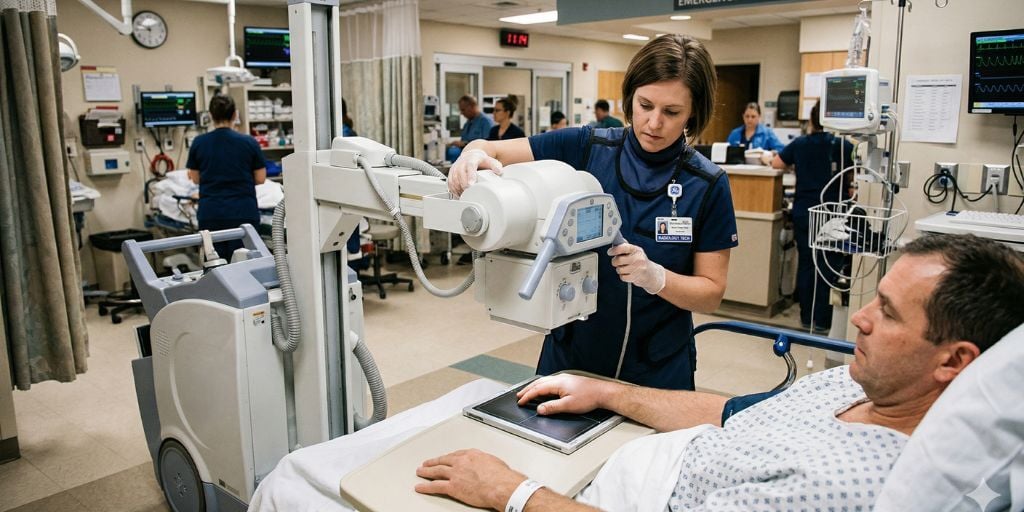
With many healthcare leaders rethinking traditional workflows as they balance staffing challenges, patient expectations, and financial pressures, portable imaging equipment has moved from a convenient option to a practical solution that meets both clinical and operational goals.
So, what makes portable imaging such a valuable investment?
The answer lies in how it contributes to staff efficiency, improves patient experience, strengthens clinical outcomes, and contributes to profitability.
Let’s walk through how portable imaging systems are helping hospitals and ASCs continue to raise the bar on healthcare.
-
Improving Patient Experience with Portable Imaging Equipment
-
Driving Profitability and Operational Efficiency with Portable Imaging Equipment
What Is Portable Imaging Equipment?
Quickly recapping the basics, portable imaging equipment refers to diagnostic systems that can be moved directly to the patient’s bedside. Common examples include portable X ray machines, compact ultrasound systems, and newer mobile MRI solutions.
Stationary imaging systems, on the other hand, are fixed in dedicated radiology rooms. Patients must be transported to these areas, which introduces additional steps, coordination, and time.
The difference between transporting a patient, or not, may seem simple at first glance. However, both options can create a ripple effect across nearly every aspect of care delivery, positively or negatively.
Why Portable Imaging Matters in Hospitals and ASCs
Before going deeper, it helps to understand why portable imaging is gaining traction across the United States.
Healthcare organizations are balancing several priorities at once. They need to move patients efficiently; support reduced clinical staff and maintain financial stability. Portable imaging fits naturally into this equation because it removes much of the friction associated with traditional imaging workflows.
With this context in mind, let’s explore how portable imaging systems impact workflows.
Advantages of Portable Imaging Systems for Healthcare Staff
First, consider the routines of physicians, nurses, and technologists, their workflows, and the challenges they encounter during a shift. Portable imaging can contribute positively to how care is delivered with:
Faster Access to Diagnostic Information
Imaging at the bedside means clinicians can gather critical information without delay. Instead of waiting for transport or scheduling, teams can move directly from assessment to imaging and then to treatment decisions.
This is especially important in emergency departments, intensive care units, and post-surgical recovery areas. Immediate access to imaging can make a real difference in how confidently and efficiently decisions and diagnoses are made.
Reduced Coordination and Physical Demand
Patient transport often requires coordination across multiple departments. It can also be physically demanding, particularly when dealing with critically ill or immobile patients.
Portable imaging reduces the need for patient movement. Nurses and transport staff spend less time coordinating logistics, and more time caring for their patients.
Improving Patient Experience with Portable Imaging Equipment
Now let’s turn to the patient perspective on portable imaging systems. These systems offer patients:
Greater Comfort
Patients may feel more comfortable staying in their rooms for imaging procedures. This is particularly true for those recovering from surgery, older adults, and individuals with limited mobility.
Increased Safety
Moving patients across a facility introduces risks such as falls or disruption of lines and monitoring equipment. Portable imaging minimizes transfer injury risks by keeping patients in place.
This becomes especially important in high acuity settings where even small disruptions can have significant consequences.
Faster Answers and Reduced Anxiety
Waiting for imaging results can be stressful. Portable imaging shortens that waiting period by bringing diagnostics directly to the patient.
Faster answers lead to quicker treatment decisions, less anxiety, and by extension improve the overall care experience.
More Access to Imaging Services
Portable systems also make imaging more accessible in settings where fixed equipment may not be practical. Smaller ambulatory surgery centers and outpatient facilities can offer imaging services without major infrastructure changes.
Elevating the Level of Care with Portable Imaging Systems
At this point, it is undeniable that portable imaging is not just about convenience. It’s role in facilitating the workflow efficiency of healthcare staff and improving patient experience combine to take patient care to the next level.
Recapping under the umbrella of elevating delivery of care, portable imaging systems offer:
Real Time Decision Making
Bedside imaging gives clinicians immediate insight into a patient’s condition.
In urgent situations, such as trauma or cardiac events, immediate results can directly influence outcomes.
Consistency Across Care Settings
Within Hospitals and ASCs it is common for clinicians to manage patients across multiple departments. Portable imaging ensures that diagnostic capabilities are available wherever the patient is located. This consistency also helps standardize care.
Alignment with Trending Healthcare Models
Value based care continues to shape how healthcare is delivered in the United States. Portable imaging aligns well with the value-based model by improving efficiency, reducing delays, and facilitating patient centered care.
Driving Profitability and Operational Efficiency with Portable Imaging Systems
Of course, these days, clinical benefits must also align with financial performance. Portable imaging supports both. Here’s how:
Lower Operational Costs
Reducing patient transport needs decreases labor demands and simplifies workflows. Facilities can also reduce reliance on outsourced imaging services, which keeps more revenue in house.
Improved Patient Throughput
Faster imaging leads to more efficient patient flow. Emergency departments can move patients through care pathways more quickly, and ASCs can maintain tighter surgical schedules.
This improved throughput can increase capacity without requiring additional space.
New Revenue Opportunities
Offering imaging services on site can attract more patients and referring providers. Portable imaging systems make it possible to expand services without major capital investment.
Over time, this flexibility evolves into sustainable revenue growth.
Portable vs Stationary Imaging Systems: Key Differences
With all the benefits offered by portable imaging systems the question becomes, how does portable imaging compare with traditional stationary systems?
Let’s take a look.
Image Quality
As a direct result of their power and size, stationary systems have historically delivered higher resolution images. However, advances in detector technology and image processing have significantly improved portable imaging quality.
Portable systems produce high quality images suitable for many diagnostic needs. Certain advanced studies still require fixed equipment, but the gap continues to narrow.
Diagnostic Accuracy
Accuracy depends on both image quality and clinician expertise. Portable imaging supports reliable diagnosis when used by trained professionals.
Immediate imaging can also improve diagnostic confidence since clinicians can correlate findings with real time observations.
Patient Comfort
This is where portable imaging clearly stands out. Bedside imaging reduces movement and discomfort and by extension lowers the risk of inadvertent injury to the patient.
Stationary systems remain essential for complex imaging, yet they often require repositioning and transport, which can be challenging for many patients.
Leading Portable Imaging Equipment Manufacturers
It is also worth noting the companies driving innovation in this space. Several manufacturers continue to shape the portable imaging market in the United States.
Leading names including:
-
GE HealthCare,
-
Philips Healthcare,
-
Siemens Healthineers,
-
Fujifilm Healthcare, and
-
Canon Medical Systems.
Additional contributors such as Mindray, Samsung Medison, and Terason continue to advance portable ultrasound and point of care imaging technologies.
Ongoing innovation from these companies will expand what portable imaging can achieve in clinical practice.
Portable imaging equipment has become an essential tool for hospitals and ambulatory surgery centers. With advances in technology continuing to close the gap between portable and stationary systems image quality and diagnostic accuracy, portable imaging are an increasingly reliable option for a wide range of clinical scenarios.
Healthcare organizations who invest in these systems are better positioned to meet the evolving demands of care delivery while at the same time, support their staff, improving patient outcomes, and strengthening financial performance.
Partner with CME Corp. for Portable Imaging Systems
Trust CME Corp., experts in capital healthcare equipment, including portable imaging systems that not only conform to current needs but also position facilities for the future.
CME Account Managers are healthcare equipment savvy. In tandem with our Imaging Solution Specialists, their expert guidance can help you evaluate portable imaging system features, so you select the units that best align to your needs.
Through trusted relationships with top portable imaging equipment manufacturers, CME Corp. is prepared to recommend alternative systems that preserve performance and reliability when supply chain challenges or budget limitations come into play.
 Find Your Account Manager or click CHAT to begin the conversation about your upcoming portable imaging system needs.
About CME: CME Corp is the nation’s premier specialty distributor of healthcare, laboratory, and imaging equipment. We partner with over 2,000 manufacturers to offer more than 2 million products. In addition to an extensive product portfolio, we also offer project management, CAD-based layout & design, warehousing, assembly, staging, consolidated direct-to-site delivery, and biomedical and technical services, all staffed by CME employees. Our mission, to help healthcare facilities nationwide reduce the cost of the equipment they purchase, make their equipment acquisition, delivery, installation, and maintenance processes more efficient, and help them seamlessly launch, renovate, or expand on schedule, is supported by 25 service locations strategically located across the country.