

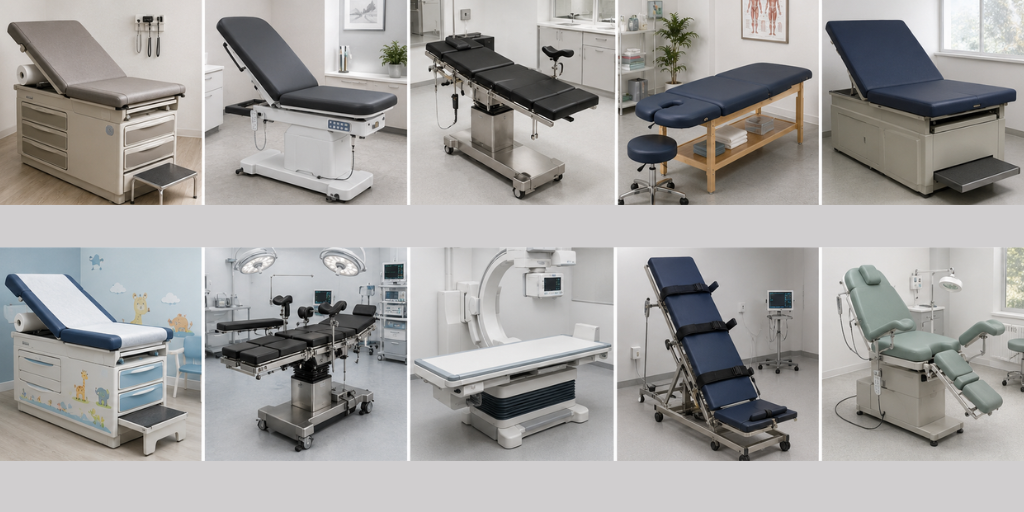
Exam tables are more than healthcare furniture. They facilitate unobstructed patient access, clinician workflow, safety, comfortable patient positioning, and can impact the overall efficiency of environments.
Choose well and the table quietly supports the work of the room all day.
Choose poorly and it can create avoidable obstacles for patients, clinicians, and workflows.
Question: How Many Different Types of Medical Exam Tables Are There?
Answer: at least 10.
Here they are:
- Manual exam tables
- Power exam tables
- Procedure tables
- Treatment tables
- Bariatric exam tables
- Pediatric exam tables
- Operating tables
- Imaging tables
- Tilt tables
- Specialty tables
Each type is designed for a specific care environment, patient need, or clinical workflow. A primary care clinic may need manual or power exam tables, while dermatology practices benefit from procedure tables. A radiology department may require imaging tables, and a pediatric practice needs tables designed for children and caregivers.
 Shop CME Corp. for Medical Exam Tables
Medical Exam Table Comparison Guide
|
Type of Exam Table |
Best For |
Key Features |
Common Settings |
|
Routine exams and general care |
Step, pull-out footrest, storage, adjustable headrest |
Primary care, clinics, family medicine |
|
|
Accessible exams and easier positioning |
Motorized height adjustment, powered positioning, low access height |
Primary care, specialty clinics, older adult care |
|
|
Minor procedures and specialty care |
Articulating sections, power controls, accessory options |
Dermatology, ENT, OB/GYN, podiatry |
|
|
Therapy and hands-on care |
Padded surface, adjustable options, open access around table |
Physical therapy, rehab, chiropractic care |
|
|
Care for larger patients |
Higher weight capacity, wider surface, reinforced frame |
Hospitals, clinics, bariatric programs |
|
|
Infant and child exams |
Smaller size, safety features, child-friendly design, storage |
Pediatric practices, family medicine |
|
|
Operating table |
Surgical procedures |
Advanced positioning, accessory compatibility, surgical support |
ORs, ASCs, surgical suites |
|
Diagnostic imaging and image-guided care |
Radiolucent surfaces, imaging compatibility, positioning support |
Radiology, ultrasound, CT, MRI, fluoroscopy |
|
|
Syncope testing and diagnostic positioning |
Controlled tilt movement, patient straps, stability |
Cardiology, neurology, rehab |
|
|
Specific clinical applications |
Purpose-built features by specialty |
Sports medicine, women’s health, behavioral health |
With the major categories in view, it helps to look more closely at how each table type supports specific care settings, patient needs, and clinical workflows
1.Manual Exam Tables
Manual exam tables are a non-powered medical table used for routine examinations, assessments, and basic clinical care.
Manual exam tables, sometimes called box tables, are the classic exam room workhorse. They are practical, familiar, and often include built-in storage. Most models feature a padded top, adjustable headrest, pull-out footrest, step, and drawers or cabinets.
Manual exam tables are commonly used in:
- Primary care offices
- Family medicine clinics
- Community health centers
- General outpatient settings
- Multi-specialty practices
Manual tables work well when storage, budget, and standard exam room function are priorities. The primary consideration is patient access. Since patients usually need to step up onto the table, manual tables may not be ideal for accessible exam rooms or patients with limited mobility.
2.Power Exam Tables
Power exam tables are motorized medical tables that can be raised, lowered, and position patients using electric controls.
Power exam tables are often called electric exam tables or high-low exam tables. They are becoming staples in exam rooms because they simplify patient access and clinician ergonomics. Many models descend to chair height, which can make transfers easier for patients with mobility limitations.
These exam tables are commonly used in:
- Primary care
- Specialty practices
- Geriatric care
- Accessible exam rooms
- High-volume outpatient clinics
- Facilities focused on staff ergonomics
Power tables can help staff by reducing repetitive bending, lifting, and awkward positioning during exams. For clinicians who have historically adjusted table height repeatedly throughout the day, power positioning can make a real difference. Over time, those ergonomic improvements can make a meaningful difference for clinical teams.
3. Procedure Tables
A procedure table is a medical table or chair designed for minor medical procedures that require precise patient positioning and clinician access.
Procedure tables often include power height adjustment, programmable positions, articulating back and leg sections, accessory rails, and specialty attachments. Some models also rotate, which can improve room workflow and access to the patient.
Procedure tables are commonly used in:
- Dermatology
- ENT
- OB/GYN
- Podiatry
- Plastic surgery
- Outpatient procedure rooms
- Ambulatory care settings
Procedure tables are a valuable choice for clinical teams that require more positioning flexibility than a standard exam table can offer.
4. Treatment Tables
A treatment table is a padded clinical table used for therapy, rehabilitation, chiropractic care, massage therapy, and hands-on treatment.
Treatment tables may be fixed-height, adjustable, or powered. Some include storage, while others use a simple open design so clinicians can move around the patient more easily.
Treatment tables are commonly used in:
- Physical therapy
- Occupational therapy
- Rehabilitation
- Chiropractic care
- Sports medicine
- Massage therapy
- General treatment areas
When selecting a treatment table, consider table height, padding, width, patient transfer needs, cleaning requirements, and whether storage features are useful for the workflow. Storage can be helpful, but only when it supports the actual workflow of the room.
5. Bariatric Exam Tables
Bariatric exam tables are reinforced medical tables designed with greater weight capacity, wider patient support, and stable positioning for larger patients.
Bariatric tables support safe, dignified, and accessible care. Many models include power height adjustment, wide surfaces, reinforced frames, handrails, and accessories that help with patient transfers.
Bariatric exam tables are commonly used in:
- Primary care
- Hospitals
- Specialty clinics
- Bariatric programs
- Community health centers
- Accessible exam rooms
Healthcare organizations should consider bariatric exam tables when patient access, safe transfers, and inclusive care are priorities. The table should support the patient population, clinical workflow, and space available in the room.
6. Pediatric Exam Tables
Pediatric tables, designed for infants, toddlers, children, and pediatric care teams, are typically smaller than adult exam tables and may include built-in scales, safety rails, storage, and child-friendly designs. These features can help make exams easier for children, caregivers, and clinicians.
Pediatric exam tables are commonly found in:
- Pediatric practices
- Family medicine clinics
- Community health centers
- Hospital pediatric departments
- School-based health clinics
Colorful designs and finishes are not just decorative, they are intentional features designed to help reduce anxiety for young patients.
7. Operating Tables
An operating table is a surgical table designed to position and support patients during procedures in operating rooms and surgical suites.
These tables may feature advanced positioning capabilities, specialty accessories, imaging compatibility, and procedure-specific configurations. They are often selected based on surgical specialty, patient positioning requirements, and equipment compatibility.
Operating tables are commonly used in:
- Hospital operating rooms,
- Specialty surgical suites
- Ambulatory surgery centers
Selecting the right operating table is contingent on the procedure mix, room layout, imaging requirements, accessory needs, and long-term surgical workflow.
8. Imaging Tables
An imaging table is a medical table designed for diagnostic imaging, image-guided procedures, and compatibility with imaging equipment.
Imaging tables may feature radiolucent surfaces, positioning features, accessory compatibility, and clearance for equipment movement. Some are built for specific modalities, while others support broader diagnostic use.
Imaging tables are commonly found in:
- Radiology departments
- Ultrasound rooms
- Imaging centers
- CT environments
- MRI settings
- Fluoroscopy rooms
- Interventional procedure suites
Before choosing an imaging table, review modality compatibility, typical patient weight capacity, transfer needs, room clearance, and workflow between the table and imaging equipment.
9. Tilt Tables
A tilt table is a diagnostic medical table that can be adjusted to various angled positions without moving the patient off the table.
Tilt tables are often used for syncope testing, which helps clinicians evaluate fainting or dizziness related to changes in body position. During testing, the table moves from horizontal to angled or upright positions while the care team monitors the patient.
Tilt tables are commonly used in:
- Cardiology
- Neurology
- Rehabilitation
- Diagnostic testing departments
Important features include stable movement, secure patient straps, smooth angle adjustment, reliable controls, and patient comfort during testing.
10. Specialty Tables
A specialty exam table is a purpose-built table designed for a specific clinical use, patient population, or care environment.
Specialty tables may include OB/GYN tables, mat platforms, athletic training tables, phlebotomy chairs, behavioral health tables, rehabilitation tables, and other application-specific models.
These tables are commonly used for:
- Women’s health
- Sports medicine
- Rehabilitation
- Behavioral health
- Long term care
- Specialty clinics
- Procedure-focused practices
Specialty tables are often the best choice when a standard exam table does not match the clinical task, patient need, or room workflow.
How to Choose the Best Exam Table for Your Facility
The best medical exam table is the one that matches the care setting, patient population, clinician workflow, accessibility requirements, and room design.
Before purchasing exam tables, healthcare teams should consider:
- Type of exams or procedures performed in the room
- Patient age, size, mobility, and transfer needs
- Accessibility goals for the care environment
- Table height range and positioning features
- Weight capacity and surface width
- Storage requirements
- Infection control and cleanability
- Accessory needs
- Room dimensions and door clearances
- Delivery, assembly, staging, and installation requirements
- Long-term service and replacement planning
A table may look right in a product photo and still be wrong for the space. If it blocks a cabinet, crowds the clinician, or makes patient transfers harder, it can affect the room’s efficiency every day.
Best Exam Table by Clinical Setting
|
Clinical Setting |
Recommended Table Types |
Why It Matters |
|
Primary care |
Manual exam table, power exam table |
Supports routine exams, storage, patient access |
|
Accessible exam room |
Power exam table, bariatric exam table |
Helps with transfers and mobility needs |
|
Pediatrics |
Pediatric exam table |
Sized and designed for children and caregivers |
|
Dermatology |
Procedure table |
Supports positioning for minor procedures |
|
OB/GYN |
Procedure table, specialty table |
Supports specialty positioning and accessories |
|
Physical therapy |
Treatment table |
Allows hands-on access and patient movement |
|
Bariatric care |
Bariatric exam table |
Supports higher weight capacity and wider surfaces |
|
Imaging |
Imaging table |
Matches modality, clearance, and positioning needs |
|
Surgery |
Operating table |
Supports surgical positioning and accessories |
|
Cardiology or neurology testing |
Tilt table |
Supports controlled diagnostic positioning |
Partner with CME Corp for Exam Table Acquisition
Once a healthcare team identifies the right exam table for the facility’s needs, the next step is making sure it complies with the latest ADA requirements, fits the space, supports workflow, arrives on schedule, and is ready for use. That requires more than product selection. It requires coordination across planning, purchasing, logistics, delivery, and installation.
Selecting the right exam table is only one part of a successful equipment purchase. Healthcare teams may also need space planning, acquisition coordination, logistics services, delivery, placement, and installation.
CME Corp is your one-stop partner for medical exam tables.
CAD-based layout, design and 3D modeling services help teams evaluate exam tables and related equipment within the clinical space before purchase. This can be especially useful for accessible exam rooms, specialty procedure rooms, imaging spaces, and high-volume outpatient clinics where table placement, clearances, storage, seating, carts, and workflow zones all need to work together.
For more complex purchases, CME Corp’s project management services help coordinate customers, vendors, account managers, warehouse teams, and Direct-to-Site delivery teams. This support can include order tracking, shipping updates, issue resolution, delivery planning, and installation coordination.
Warehousing and Direct-to-Site services can also simplify healthcare equipment acquisition. Equipment can be received, assembled, staged, delivered, and installed in its final service location by CME-employed teams experienced in healthcare environments.
The right exam table matters, but so does the process that gets it into the right room at the right time. CME Corp helps connect those steps so healthcare teams can plan, purchase, and implement exam tables with fewer surprises.
 Connect with an Account Manager
Click CHAT to start the conversation about your exam table needs with a CME expert.
_______________________________________________________
Frequently Asked Questions About Medical Exam Tables
What is the most common type of medical exam table?
Manual exam tables and power exam tables are among the most common medical exam tables in outpatient care. Manual tables are practical and storage-friendly, while power tables support easier positioning and improved patient access.
What is the difference between an exam table and a procedure table?
An exam table is used for routine exams, assessments, and general patient care. A procedure table is designed for minor procedures and usually includes more positioning options, power controls, and accessory compatibility.
What is the best exam table for primary care?
The best exam table for primary care is usually a manual exam table or power exam table. Manual tables work well for standard exam rooms with storage needs. Power tables are a strong choice for accessible rooms, older adult care, and practices focused on clinician ergonomics.
Are power exam tables worth it?
Power exam tables can be a smart investment for healthcare facilities that treat patients with mobility limitations or want to improve clinician ergonomics. They allow easier height adjustment, patient positioning, and transfers.
What type of exam table is best for accessible exam rooms?
Power exam tables are often the best choice for accessible exam rooms because many models lower closer to chair height. Bariatric power tables may also be appropriate when higher weight capacity and wider surfaces are needed.
What type of exam table is best for pediatric care?
Pediatric exam tables are best for pediatric care because they are sized for infants and children. Many models include safety features, built-in scales, storage, and child-friendly designs.
What should healthcare facilities consider before buying exam tables?
Healthcare facilities should consider clinical use, patient access, weight capacity, room layout, storage, cleanability, accessories, delivery requirements, and installation needs before buying exam tables.
About CME: CME Corp is the nation’s premier specialty distributor of healthcare, laboratory, and imaging equipment. We partner with over 2,000 manufacturers to offer more than 2 million products. In addition to an extensive product portfolio, we also offer project management, CAD-based layout, design and 3d modeling, warehousing, assembly, staging, consolidated, need-by-date direct-to-site delivery, and biomedical and technical services, all staffed by CME employees. Our mission, to help healthcare facilities nationwide reduce the cost of the equipment they purchase, make their equipment acquisition, delivery, installation, and maintenance processes more efficient, and help them seamlessly launch, renovate, or expand on schedule, is supported by service locations strategically located across the country.