

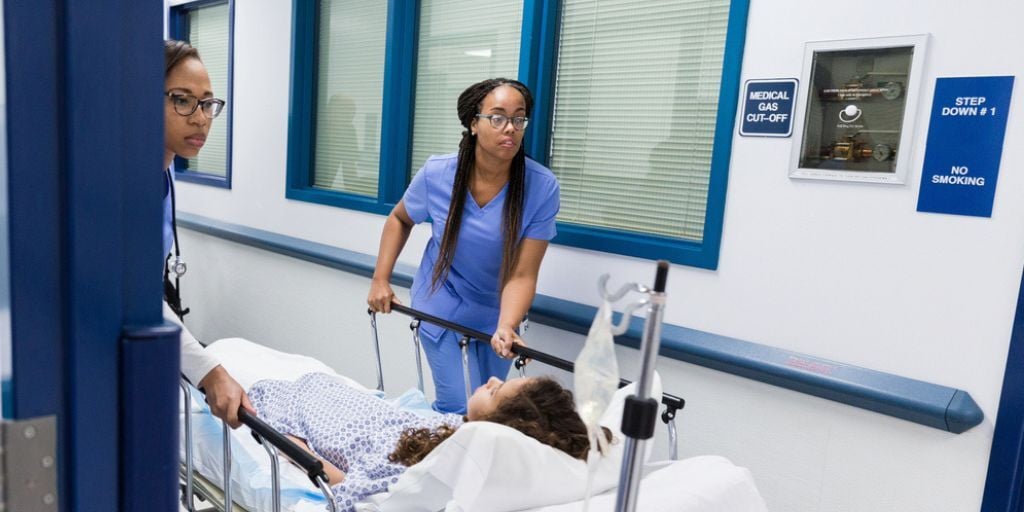
Stretchers are essential to workflow in hospitals and ambulatory surgery centers (ASCs). Healthcare professionals rely on stretchers that prioritize patient safety, minimize physical exertion, while facility administrators look to invest in healthcare equipment that offers the best quality for the available budget. Although visually, stretcher models may appear similar, their specifications and performance characteristics vary in ways that directly influence care delivery.
This overview examines
- the primary stretcher categories used in acute care and ASC environments,
- highlights differentiating features that matter in clinical practice, and
- reviews cost and service life considerations relevant to buying decisions.
Standard Transport Stretchers
Standard transport stretchers form the backbone of internal patient movement. They are typically used to transfer patients between the emergency department, imaging, perioperative areas, inpatient units, and discharge zones.
Core features generally include:
- manual hydraulic height adjustment,
- an articulating backrest,
- side rails with basic controls, and
- four swivel casters with central braking.
Weight capacities commonly range from 500 to 700 pounds and mattress systems are most often basic foam as they are intended for short duration occupancy.
Clinical considerations
For nursing and transport teams, maneuverability and brake reliability are top priorities. Fifth wheel steering or dual caster control improves tracking in long corridors. A range of height adjustments supports lateral transfers to beds and procedure tables while reducing staff strain.
Best fit
Standard transport stretchers are appropriate in environments where patients remain on the surface briefly and advanced positioning or imaging access is not needed.
Cost and service life
Capital cost typically falls between $2,000 and $6,000 per unit. With routine preventive maintenance and periodic caster and hydraulic service, these stretchers often stay in service for 8 to 12 years. High volume facilities may see shorter cycles due to mechanical wear.
Emergency Department Stretchers
Emergency department stretchers must support rapid assessment, treatment, and prolonged occupancy during boarding. In many EDs, patients spend several hours on the stretcher, making comfort and pressure management more clinically significant.
Common features include:
- Expanded height range for easier transfers
- Trendelenburg and reverse Trendelenburg positioning
- Radiolucent deck for imaging
- Integrated scale options
- Higher weight capacity
- More advanced side rail controls
Some models incorporate pressure redistribution mattresses designed to reduce skin injury risk during extended stays.
Clinical considerations
ED physicians and nurses benefit from radiolucent surfaces that allow imaging without transferring unstable patients. Integrated scales support medication dosing and fluid management. Wider side rails and robust frames accommodate a diverse patient population, including bariatric and behavioral health cases.
Best fit
High acuity emergency departments, trauma bays, and observation units are primary use settings for these stretchers.
Cost and service life
Emergency stretchers can cost from $7,000 to $20,000 each depending on imaging compatibility and electronic features. Given continuous use, service life is 7 to 10 years, though this varies with patient volume and maintenance practices.
Procedure and Interventional Stretchers
In procedural areas such as endoscopy, cardiac catheterization labs, electrophysiology suites, and pain management clinics, stretchers often function as both a transport surface and a procedure platform.
Distinguishing characteristics include:
- powered height adjustment,
- electric articulation of back and leg sections,
- radiolucent decks, and
- specialty positioning accessories.
Some models support C arm access or include removable head and foot sections.
Clinical considerations
For anesthesia providers and proceduralists (like radiology technicians), fine positioning control and stable locking mechanisms are essential. Powered articulation reduces manual adjustments during sedation or regional anesthesia while radiolucent decks allow imaging continuity without repositioning.
Best fit
Hospitals and ASCs performing minimally invasive procedures benefit from using a single surface from pre-op through recovery. This reduces transfer-related fall risk and physical strain on staff.
Cost and Service Life
Expect capital investment of between $10,000 and $30,000 per unit. In terms of longevity, structural components may last 8 to 12 years, though electronic actuators and hand controls may require earlier replacement.
Bariatric Stretchers
Bariatric stretchers address the growing need to safely transport and treat patients with higher body mass. For some patients, standard stretchers may not accommodate width or weight requirements.
Key features include:
- reinforced frames,
- wider deck surfaces,
- weight capacities up to 1,000 pounds, and
- optional powered drive systems.
Some models include expandable side rails and integrated scales calibrated for higher ranges.
Clinical considerations
Safe patient handling protocols increasingly require equipment that reduces manual exertion by staff. Consider powered drive assist systems that decrease push force and by extension lower the risk of musculoskeletal injury to staff. Wider surfaces also improve patient stability and comfort.
Best fit
Emergency departments, perioperative services, and inpatient units with higher bariatric populations have bariatric stretchers available in proportion to the average population of bariatric patients.
Cost and Service Life
Bariatric stretchers typically involve an investment of $8,000 to $25,000 per stretcher. Given the increased structural demands associated with higher weight capacities, the frame and mobility components require close inspection and, as a result, the service life is slightly reduced to between 7 and 10 years.
ASC Focused Stretchers
Compared with acute care hospitals, ambulatory surgery centers work under different throughput and space constraints. Stretchers in this environment must support efficient preop preparation, PACU recovery, and discharge processes.
Common features include:
- compact footprint,
- low minimum height for easy patient access,
- comfortable mattresses suitable for several hours of recovery, and
- simplified control interfaces.
Some convert to chair position to facilitate phase two recovery and discharge teaching.
Clinical considerations
ASC nurses value quiet casters, smooth steering, and easy cleaning surfaces. Also valued is the ability to keep the patient on one surface from admission to discharge supports infection control and reduces transfer risk.
Best fit
Same day orthopedic, ophthalmic, gastroenterology, and plastic surgery centers benefit from the more compact ASC stretcher.
Cost and service life
Capital cost typically ranges from $5,000 to $15,000. Given this investment, it is important to consider long-term durability, as ASCs work on scheduled hours with planned cases, allowing service life to extend to 10 to 15 years with proper maintenance.
Powered and Technology Integrated Stretchers
Advanced stretchers incorporate electric lift systems, motorized drive assist, and digital integration. These models are being increasingly put into service by large health systems focused on caregiver safety and operational efficiency.
Features may include:
- battery powered height adjustment,
- integrated scales,
- advanced braking systems, and
- connectivity with patient monitoring platforms.
Clinical considerations
Reducing staff injury is a strategic priority for healthcare administrators. Powered drive and lift systems decrease push and pull effort by clinicians during long transports while integrated scales support medication dosing accuracy without additional transfers.
Best fit
Level one trauma centers, large academic medical centers, and facilities with extensive transport distances are common adopters of powered and technology integrated stretchers.
Cost and Service Life
Advanced stretchers often require budgets between $15,000 and $35,000 per stretcher.
In terms of service life, batteries and electronic components may require replacement within 3 to 7 years, while frames can remain in use for more than a decade.
Key Stretcher Evaluation Criteria for Clinical Leaders
When evaluating stretcher options, healthcare professionals should assess:
- Height range and transfer compatibility with existing beds and tables
- Weight capacity alignment with patient population data
- Steering systems and brake performance
- Imaging access requirements
- Mattress pressure redistribution properties
- Cleaning protocols and infection prevention considerations
- Preventive maintenance requirements and parts availability
Total cost of ownership should include purchase price, service contracts, replacement parts, downtime impact, and potential reduction in staff injury claims.
Stretcher selection is not simply an equipment acquisition decision for healthcare professionals. The choice of stretchers directly affects patient safety, workflow efficiency, physical strain on staff, and long-term capital planning. Standard models support routine transportation, while emergency, procedural, bariatric, and powered stretchers meet more complex clinical demands.
Aligning stretcher capabilities with the patient acuity levels, procedural needs, and facility layout gives hospitals and ASCs the advantage of investing in equipment that offers both clinical excellence and financial security over the long term.
Partnering with the right healthcare equipment distributor ensures you are buying the best stretcher for your needs and budget.
Partner with CME Corp. for Stretchers
As the United States’ largest specialty distributor solely focused on equipment used in healthcare, we have built long term relationships with industry leading manufacturers and can help equip facilities with the stretchers they need to raise the bar on care delivery.
Our expert account managers will work with you and the manufacturers’ representatives to evaluate stretcher features so you can be sure you are purchasing equipment tailored to the needs of your patient population, staff, workflow, available space, and budget.
Complementing CME’s expert focus on equipment used in healthcare are CAD- based design and layout, project management, direct-to-site delivery, and biomedical services. We are the only medical equipment distributor nationwide, able to say we are truly a one-stop shop.
Direct-To-Site Logistics and Delivery Services
In-house Direct-to-Site services deliver and install medical equipment fully assembled, right to the service location, when it is convenient for staff.
Biomedical Services
CME’s in-house Biomedical Equipment Technicians (BMETs) can support facility biomed teams with scheduled annual preventive maintenance and repairs as needed as well as perform check-in assessments on new stretchers.
 Click CHAT to start the conversation about your stretcher needs.
About CME: CME Corp is the nation’s premier specialty distributor of healthcare and laboratory equipment. We partner with over 2,000 manufacturers to offer more than 2 million products across healthcare, laboratory, pharmacy, and research sectors. In addition to an extensive product portfolio, we also offer project management, CAD design, warehousing, logistics, consolidated direct-to-site delivery, and biomedical and technical services, all staffed by CME employees. Our mission, to help healthcare facilities nationwide reduce the cost of the equipment they purchase, make their equipment acquisition, delivery, installation, and maintenance processes more efficient, and help them seamlessly launch, renovate, or expand on schedule, is supported by 25 service locations strategically located across the country.