

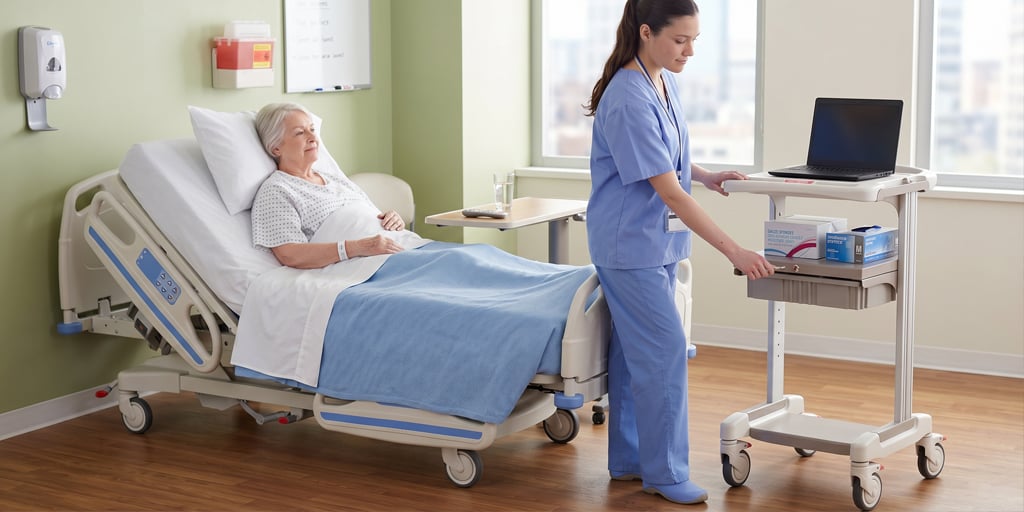
Healthcare facilities are built to keep care moving. Staff move between departments, between rooms, and increasingly, through workflows centered at the point of care. But while clinical work has become more mobile, more often than not, the spaces where that work happens have not expanded to match.
Patient rooms already hold equipment, supplies, and multiple care team members. Adding another supply cart to that environment can make it more difficult to work efficiently. At the same time, many roles depend on moving from room to room, which makes mobility just as important as storage capacity.
That shift is changing how facilities think about cart design. Instead of focusing solely on capacity, they are paying closer attention to footprint, maneuverability, and access. For facilities trying to do more within the same limited space, compact medical carts offer a practical alternative.
Workflow Challenges in Crowded Care Spaces
Healthcare professionals know that crowding isn’t limited to patient rooms. Recovery bays, inpatient units, and emergency departments all deal with the same basic issue: care happens in busy spaces, and the layout rarely changes to match increased demand.
In practice, that means staff often work around IV poles, infusion pumps, monitors, mobile workstations, oxygen or suction equipment, and the cords and tubing that come with them. When too much equipment competes for the same space, movement becomes less streamlined. Staff spend more time repositioning tools, adjusting their workspace, and working around obstacles that interrupt otherwise routine tasks.
Crowded spaces also make it harder to stage supplies consistently. When there’s no obvious place to park a cart or prepare materials, staff improvise. They set items wherever there is room, leave the patient area to grab what they need, or make multiple trips simply because the setup does not support the task.
Those small inefficiencies add up over time. They slow down routine care, create more back-and-forth, and make it harder to keep supplies close to where they are actually being used.
Why Cart Size and Mobility Matter at the Point of Care
In that kind of environment, cart size becomes a significant consideration. A cart that is too large for the space, or oversized for the supplies needed, can limit access to the patient, compete with surrounding equipment, or require constant repositioning just to stay usable.
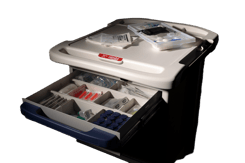 Mobility is just as important. Many point-of-care workflows do not happen in a single location, but across multiple areas. Staff move between rooms, pull supplies into temporary work areas, and need tools that can move with them without adding extra effort. In those situations, a cart must do more than store supplies. It has to move easily, fit where it is needed, and support tasks without requiring setup every time it changes locations.
Storage needs also shift. At the point of care, the goal is less about carrying as much as possible and more about keeping the right supplies organized, visible, and within reach. That means cart design has to support access and efficiency in addition to capacity.
How Compact Medical Carts Support Point-of-Care Workflows
Compact medical carts address those demands by reducing physical bulk while keeping essential task support intact. They give staff a smaller, more manageable platform to bring into the care space without giving up the basic functions that make a cart useful.
That difference shows up in several ways:
- They fit more naturally into active care areas. A smaller cart is easier to position near the patient without blocking other equipment or forcing staff to rework the room.
- They support room-to-room movement. Staff can move supplies with them instead of returning to a central staging area between tasks.
- They keep frequently used items within reach. When storage is built around actual point-of-care use, staff spend less time searching and less time stepping away.
- They reduce unnecessary bulk. Compact carts eliminate waste by carrying only what is needed for the task instead of functioning as oversized storage units.
Introducing Metro nimbl® Compact Medical Carts
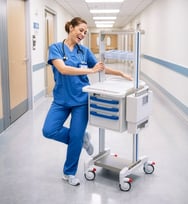 At the point of care, nurses and clinicians don’t need “more cart” to do their jobs effectively. They need a compact cart that can move easily through crowded care areas, fit into tight spaces, and still provide a usable work surface and organized access to supplies.
Metro designed Nimbl around exactly that kind of work. Rather than treating the cart as a storage unit first and a work tool second, Nimbl combines a compact footprint with a usable work surface, organized storage, and accessories that support point-of-care tasks.
The ergonomic work surface gives staff a dedicated area for quick prep, labeling, charting, or staging supplies within reach of the patient. Instead of bulk storage, the design relies on functionality: soft-close drawers, rails, bins, shelves, and accessory options enable Nimbl carts to carry the supplies needed for the task at hand while staying compact enough to move and position easily. Utilizing vertical space helps make the cart easier to manage in crowded care areas and easier to adapt across applications.
The Benefits of Nimbl at the Point of Care:
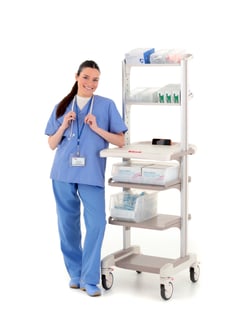 Compact footprint: Nimbl takes up less space in crowded care areas while still providing a usable work surface and organized storage, so it can easily fit into crowded rooms.
Easy mobility: the lightweight, open-concept design and brake-lock casters make the cart easier to move, reposition, and use throughout the facility.
Ergonomic work surface: the standing-height surface, raised perimeter, and rear utility trays support quick prep and point-of-care tasks.
Balanced storage: nimbl keeps essential supplies organized and accessible without adding excess compartments or unnecessary bulk.
Modular flexibility: rails, shelves, bins, drawer modules, and accessories allow the platform to be configured for different applications and workflows.
Partner with CME Corp for Metro nimbl® Compact Medical Carts
CME Corp’s expert account managers can help you configure Metro nimbl® carts to support your unique point-of-care needs, mobile storage, and other clinical workflows. From recommending features and accessories to coordinating warehousing, delivery, and installation, CME is your one-stop partner for healthcare equipment by Metro.
About Metro: For over 95 years, Metro has been the world's leading manufacturer of storage and transport equipment. From innovative wire and polymer shelving to a diverse range of modern medical carts, Metro puts space to work in healthcare facilities everywhere.
About CME: CME Corp is the nation’s premier specialty distributor of healthcare, laboratory, and imaging equipment. We partner with over 2,000 manufacturers to offer more than 2 million products. In addition to an extensive product portfolio, we also offer project management, CAD-based layout, design and 3d modeling, warehousing, assembly, staging, consolidated, need-by-date direct-to-site delivery, and biomedical and technical services, all staffed by CME employees. Our mission, to help healthcare facilities nationwide reduce the cost of the equipment they purchase, make their equipment acquisition, delivery, installation, and maintenance processes more efficient, and help them seamlessly launch, renovate, or expand on schedule, is supported by service locations strategically located across the country.