

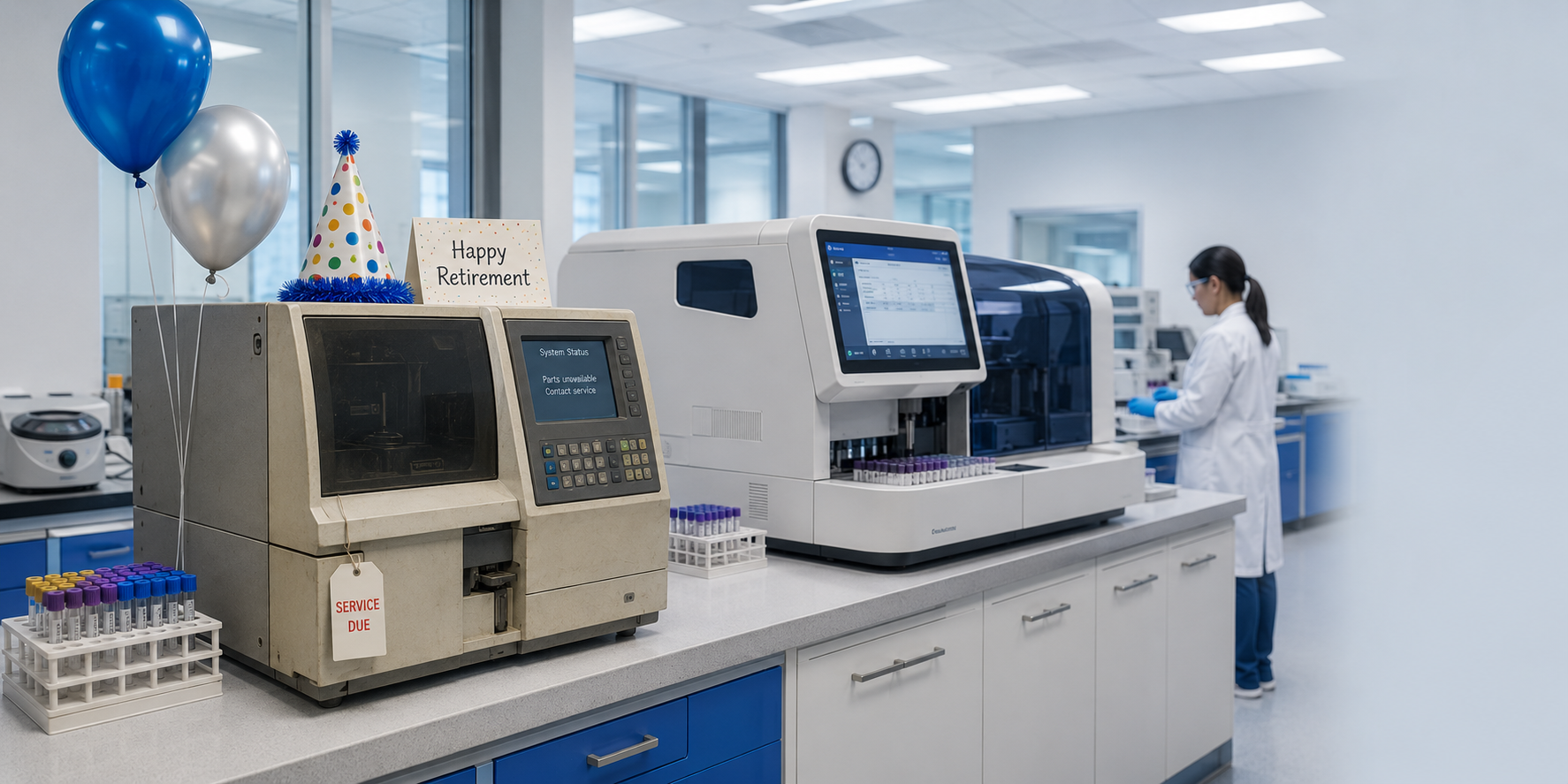
It’s a rule of the universe: laboratory equipment rarely fails on a convenient schedule.
An analyzer may begin producing intermittent error messages during the morning rush. A centrifuge may require another service visit only weeks after its last repair. A refrigerator that has performed reliably for years may suddenly struggle to maintain its required temperature range.
Each event can appear manageable on its own. Staff troubleshoot the problem, call a technician, move specimens, adjust schedules, and keep the laboratory running.
Over time, however, those workarounds carry a cost.
The true cost of aging laboratory equipment includes more than repair invoices. It can include:
- delayed test results,
- staff overtime,
- disrupted clinical workflows,
- repeat testing,
- emergency rentals,
- courier expenses,
- lost capacity, and
- increased pressure on already busy laboratory teams.
Recognizing those potential costs early gives healthcare organizations more time to evaluate options, coordinate budgets, and replace equipment before a manageable concern becomes an operational emergency.
What Is Considered Aging Laboratory Equipment?
Aging laboratory equipment is not defined only by number of years in service.
Useful life depends on:
- test volume,
- operating environment,
- maintenance history,
- software compatibility,
- cleaning practices,
- availability of replacement parts, and
- manufacturer service coverage.
Equipment should be considered an aging asset when its reliability, serviceability, performance, or workflow fit begins to decline.
Common flags include:
- More frequent service calls
- Increasing repair costs
- Longer waits for replacement parts
- Repeated calibration or quality-control issues
- Unsupported software or operating systems
- Expiring manufacturer service coverage
- Limited access to trained technicians
- More frequent staff workarounds
- Capacity that no longer matches current test volume
- Difficulty integrating with newer laboratory systems
Equipment management is a recognized component of laboratory quality management because accurate, reliable, and timely testing depends partly on properly selected, maintained, and monitored instruments.
Age matters, but operational performance tells a more complete story.
The Most Visible Cost: Repairs and Service Calls
Repair expenses are usually the easiest costs to identify.
Older equipment may need new sensors, seals, motors, circuit boards, refrigeration components, or software repairs.
Labor rates may rise, and parts may become harder to locate.
Service agreements may also become more expensive or offer narrower coverage as equipment approaches the end of its expected service life.
Yet the repair invoice often captures only one part of the cost.
The laboratory may also spend money on:
- expedited shipping,
- after-hours service,
- temporary equipment,
- outsourced testing, or
- staff overtime.
Department leaders may need to pause other work to coordinate the response.
Procurement teams may have to locate parts or alternative instruments with little notice.
A repair that looks affordable in isolation may be far more expensive when these secondary costs are included.
That is why repair-versus-replace decisions should not be based solely on whether an instrument can be repaired. The better question is whether continuing to repair it remains operationally and financially reasonable.
Downtime Can Quickly Become a Capacity Problem
When a laboratory instrument is unavailable, the work does not disappear.
Specimens continue to arrive.
Clinicians continue to need results.
Staff must redirect testing to another instrument, another department, or an outside laboratory.
A backup analyzer may absorb some volume, but that added workload can create a new bottleneck.
- Batch sizes may increase.
- Routine maintenance may be delayed.
- Staff may need to prioritize urgent tests while less urgent work accumulates.
Even short periods of downtime can affect:
- Test turnaround times
- Daily throughput
- Staffing requirements
- Specimen routing
- Courier schedules
- Inventory consumption
- Quality-control activities
- Communication with clinical departments
Planned maintenance is typically easier to manage because teams can adjust schedules and prepare backup processes. Unplanned downtime creates more uncertainty and often forces staff to make rapid decisions with limited options.
The operational lesson is straightforward: reliability has value, even when it does not appear as a separate budget line.
Testing Delays Can Disrupt Clinical Workflows
Laboratory turnaround time affects decisions throughout a healthcare organization.
A delayed result may hold up:
- treatment decisions,
- discharge planning,
- bed movement,
- procedure schedules, or
- follow-up communication.
The exact effect depends on the test and care setting, but the disruption can extend well beyond the laboratory.
A single equipment failure can create a chain reaction:
- Testing is paused or rerouted.
- Specimens wait longer for processing.
- Results reach clinical teams later than expected.
- Staff spend additional time checking status or communicating delays.
- Other departments adjust their workflows around the missing information.
Not every delay changes patient care. Still, repeated delays can weaken confidence in expected turnaround times and increase coordination work across departments.
This is where the hidden cost becomes especially important. An instrument may remain technically functional while no longer meeting the organization’s practical need for dependable, timely testing.
Aging Equipment Creates More Work for Laboratory Staff
Older equipment often requires more attention from experienced employees.
Over time staff learn:
- which error codes can be cleared,
- which components need extra monitoring, or
- which startup sequence is most likely to prevent a shutdown.
That knowledge can keep an instrument operational, but it also creates dependence on informal expertise.
The laboratory may become vulnerable when the person who knows the equipment best is unavailable.
Additional labor may include:
- Repeating startup procedures
- Monitoring temperatures more frequently
- Running additional quality-control checks
- Reprocessing specimens
- Documenting recurring failures
- Contacting service vendors
- Training staff on temporary workarounds
- Moving work between instruments or locations
- Explaining delays to other departments
Over time, these tasks consume hours that could be used for testing, training, process improvement, or other laboratory priorities.
Staff frustration matters as well. Repeated equipment problems can make an already demanding work environment more difficult. A replacement decision may therefore affect workforce efficiency and daily experience, not only capital planning.
Quality-Control Problems Can Signal Larger Equipment Risk
Intermittent quality-control problems deserve careful attention.
Aging components, unstable temperatures, worn mechanical parts, calibration drift, or inconsistent performance may require more frequent investigation. Staff may need to repeat controls, recalibrate the instrument, review maintenance records, or determine whether patient testing can continue.
An occasional quality-control issue does not automatically mean an instrument should be replaced. But patterns matter.
Leaders should look for trends such as:
- Increasing calibration frequency
- Recurring control failures
- Longer troubleshooting time
- Repeated service calls for the same issue
- Growing reagent or specimen waste
- More frequent test reruns
- Difficulty documenting a stable corrective action
When these patterns appear together, the laboratory may be spending more effort preserving an unreliable process than planning a more dependable one.
Obsolete Software and Parts Can Extend Downtime
Mechanical wear is only one source of risk.
Many laboratory instruments depend on embedded software, connected workstations, interfaces, and operating systems. Equipment may continue performing its core function while becoming difficult to connect, secure, update, or service.
Older equipment can create challenges when:
- The operating system is no longer maintained
- Interface software is incompatible with newer systems
- The manufacturer has discontinued updates
- Replacement computers require unsupported configurations
- Proprietary components are no longer produced
- Service technicians need parts from a shrinking inventory
- Network or cybersecurity requirements have changed
Parts availability is especially important because it affects both the likelihood and duration of downtime. A repair may be technically possible, but a long wait for the required component can leave the laboratory without usable equipment for days or weeks.
Replacement planning should include conversations with the manufacturer or service organization about end-of-service dates, software roadmaps, parts availability, and expected response times.
Total Cost of Ownership Offers a Better Decision Framework
Purchase price alone does not show what a device will cost over its useful life.
Total cost of ownership considers the direct and indirect expenses associated with acquiring, operating, maintaining, and eventually replacing equipment.
A laboratory equipment review should include:
- Purchase or lease cost
- Site preparation
- Electrical, plumbing, ventilation, or data requirements
- Reagents and consumables
- Preventive maintenance
- Service contracts
- Unplanned repairs
- Staff training
- Quality-control materials
- Software and interface expenses
- Downtime
- Outsourced testing
- Deinstallation and disposal
- Replacement planning
This broader analysis can also be applied to existing equipment. Leaders can compare the annual cost of keeping an older instrument in service with the estimated cost and operational value of a replacement.
A newer instrument is not automatically the better choice. Workflow fit, test menu, standardization, service coverage, space, training requirements, manufacturer reliability, and available capital all matter.
The goal is not to replace equipment simply because it is old. The goal is to identify when the cost and risk of continued ownership exceed the value the equipment delivers.
How Can Laboratories Identify Replacement Priorities?
A structured equipment risk assessment can help laboratories move beyond reactive decisions.
Start by creating or updating an inventory that includes:
- Equipment type and location
- Manufacturer and model
- Installation date
- Service history
- Preventive maintenance status
- Warranty or service-contract details
- Software version
- Parts availability
- Current utilization
- Backup capacity
- Replacement lead time
- Clinical or operational dependency
Next, rank each asset according to failure likelihood and operational impact.
Equipment with a moderate chance of failure may deserve high priority when no backup exists. Another instrument may have frequent service issues but create limited disruption because testing can easily move to a nearby system.
Consider the answers to these questions:
How often has the device failed?
Look beyond the number of service calls. Review the length of each outage, repeat failures, internal troubleshooting hours, and whether the same component has been repaired more than once.
What happens when the equipment is unavailable?
Document where testing goes, how much volume the backup system can accept, which departments are affected, and how long the laboratory can operate before backlogs develop.
Can parts and trained technicians still be obtained?
Ask manufacturers and service partners about expected parts availability, service coverage, software maintenance, and end-of-life timelines.
Does the equipment still fit the current workflow?
Test menus, volumes, staffing models, connectivity needs, and facility layouts change. Reliable equipment can still become inefficient when the surrounding workflow has evolved.
How long would replacement take?
Lead time may include sourcing, budgeting, facility preparation, delivery, installation, validation, staff training, interface work, and removal of the old system. Waiting until failure can eliminate the ability to plan these steps carefully.
Together, these questions help turn equipment replacement into a risk-management process rather than an emergency purchase.
Proactive Planning Reduces Disruption
Capital planning works best when laboratory, clinical, facilities, IT, finance, supply chain, and procurement teams communicate early.
A replacement project may require more than selecting a new model. Teams may need to evaluate electrical capacity, utility connections, counter space, door clearances, network access, ventilation, nearby storage, and installation sequencing.
They may also need to coordinate:
- Temporary testing plans
- Reagent transitions
- Staff training
- Method verification
- Data interfaces
- Delivery restrictions
- Removal of the existing instrument
- Infection-prevention or construction requirements
- Manufacturer installation schedules
Early planning creates room to compare options and align the project with operational needs. It can also reduce premium freight, emergency sourcing, rushed site preparation, and avoidable downtime.
The bridge between equipment management and patient care is often operational readiness. A well-planned replacement helps the laboratory maintain continuity while moving to a system better suited to its current needs.
Partner with CME Corp. for Laboratory Equipment
Partner with CME Corp. when the decision has been made to replace aging laboratory equipment.
Our expert laboratory equipment Account Managers work with laboratories and healthcare organizations to help identify the best laboratory equipment for the needs and workflow of the lab.
Direct-to-Site delivery and installation of lab equipment by CME-employed teams helps ensure the devices are delivered when it is convenient for staff and ready for immediate use.
Planning a laboratory equipment purchase or broader replacement initiative?
 Click CHAT to talk with a CME representative about your laboratory equipment needs.
Frequently Asked Questions About Aging Lab Equipment
How old is too old for laboratory equipment?
There is no universal retirement age. Evaluate service history, reliability, utilization, software status, parts availability, manufacturer guidance, quality-control performance, and backup capacity.
Should equipment be replaced after a certain number of repairs?
A repair count alone may be misleading. Review repair frequency, total expense, outage duration, repeat failures, labor demands, and the operational impact of each event.
What are the hidden costs of laboratory equipment downtime?
Hidden costs may include staff overtime, repeat testing, wasted reagents, outsourced testing, courier expenses, delayed workflows, temporary rentals, lost capacity, and management time.
What is the difference between preventive maintenance and replacement planning?
Preventive maintenance helps keep equipment operating according to manufacturer recommendations. Replacement planning prepares the organization to retire an asset before reliability, serviceability, or workflow limitations create unacceptable risk.
Who should participate in laboratory equipment replacement decisions?
The right group depends on the project, but it may include laboratory leadership, end users, procurement, supply chain, facilities, IT, finance, infection prevention, biomedical or clinical engineering, and the equipment manufacturer or distributor.
About CME: CME Corp is the nation’s premier specialty distributor of healthcare, laboratory, and imaging equipment. We partner with over 2,000 manufacturers to offer more than 2 million products. In addition to an extensive product portfolio, we also offer project management, CAD-based layout, design and 3d modeling, warehousing, assembly, staging, consolidated, need-by-date direct-to-site delivery, and biomedical and technical services, all staffed by CME employees. Our mission, to help healthcare facilities nationwide reduce the cost of the equipment they purchase, make their equipment acquisition, delivery, installation, and maintenance processes more efficient, and help them seamlessly launch, renovate, or expand on schedule, is supported by service locations strategically located across the country.