

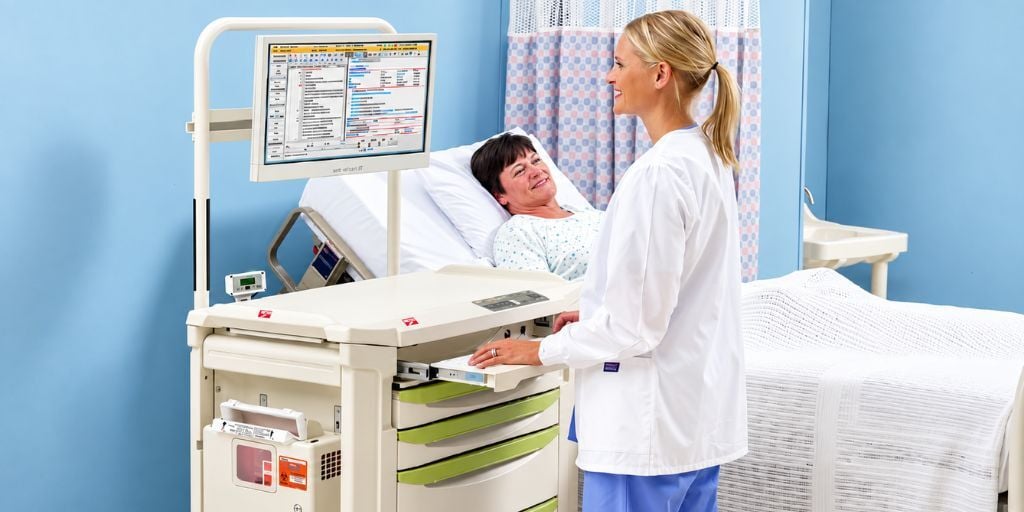
In hospitals and other healthcare facilities, nurses and other clinicians are responsible for far more than direct patient care. Throughout a single shift, they may administer medications, gather supplies, assist with procedures, respond to changing patient needs, and coordinate with other members of the care team.
Managing all these responsibilities often requires constant movement around the facility. A 2019 time-and-motion study of hospital nurses found that nurses spent about 31% of their time on direct patient care, while the rest was divided among charting and other activities such as retrieving medications and supplies, communicating with other healthcare professionals, and traveling between patients.
For tasks that require frequently used supplies or equipment, unnecessary trips away from the patient can add interruptions to an already busy workflow. Mobile medical carts bring supplies, medications, equipment, and work surfaces closer to the point of care, giving clinicians a way to keep commonly used resources within reach.
Here are six ways mobile medical carts support modern healthcare workflows.
1. Faster Access to Essential Supplies
Nurses depend on quick access to supplies when administering medications, starting IVs, performing wound care, assisting with bedside procedures, and completing other routine tasks. When those materials are stored in a central supply area, even a straightforward task can require multiple trips away from the patient.
Mobile medical carts allow essential supplies to travel with the caregiver. Instead of stopping to retrieve items throughout a procedure or treatment, nurses can keep what they need organized and within reach.
This can make routine tasks easier to complete without repeatedly leaving the care area. Over the course of a shift, fewer trips to retrieve supplies can add up to meaningful time savings.
2. Less Time Spent Searching for Equipment
Finding equipment can be just as frustrating as retrieving supplies. When staff does not know where an item is located, or when supplies are placed wherever space is available, a simple search can interrupt the workflow and delay the next task.
A properly stocked mobile cart gives frequently used supplies a designated location. Drawers, bins, shelves, labels, and accessories can separate materials by task or product type, making it easier for staff to find what they need quickly.
That organization is particularly useful when carts are shared across shifts. Departments can establish a consistent setup, so staff know where supplies belong and can quickly identify what needs to be restocked.
3. More Efficient Nursing Workflows
Nursing workflows rarely follow a predictable sequence. A clinician may move between patient rooms, respond to an urgent request, document care, gather additional supplies, and assist with a procedure within a short period of time.
Without the right tools, each transition can create another interruption. Staff may need to return to a nursing station to document care, visit a storage area for additional supplies, or reposition equipment before they can continue working.
Mobile medical carts help bring several of these resources together in a single mobile workspace. Depending on the application, a cart may combine supply storage, a work surface, secure drawers, documentation tools, or procedure-specific accessories.
Instead of moving between several fixed locations, nurses can take a more complete workspace with them. This is especially useful for tasks that require several supplies or tools at the bedside. Keeping those items together can reduce the number of times staff have to stop what they are doing to retrieve something else.
4. Greater Flexibility Across Clinical Applications
A single nursing unit may use mobile carts for medication delivery, wound care, IV therapy, admissions, isolation supplies, bedside procedures, or general supply storage. Each of those applications places different demands on the cart.
For example, a medication cart may prioritize secure storage and organization, while a wound care cart may need room for dressings, cleansers, gloves, and disposal supplies. Treatment carts may require a larger work surface or specialized accessories. Emergency response carts, meanwhile, need to keep critical equipment and supplies organized and immediately accessible.
Because these workflows differ, cart selection should be based on more than overall storage capacity. Facilities also need to consider which supplies the cart will carry, who will use it, where it will move, and how staff need to access its contents.
Configurable medical carts give facilities more flexibility to match the cart to the application. Cart size, drawer layout, accessories, security features, and work surfaces can be selected based on what staff actually need to store and access.
5. More Time at the Bedside
Time spent retrieving supplies, searching for equipment, or moving between workstations is time nurses cannot spend directly with patients.
Keeping commonly used supplies and equipment close to the point of care can reduce some of the unnecessary trips that take staff away from the bedside. Mobile carts give clinicians a way to bring those resources with them, rather than returning to a central storage area each time another item is needed.
Mobile carts cannot remove every administrative or logistical demand from a nurse’s shift. However, having supplies and equipment available where care is being delivered can make it easier for clinicians to stay focused on the task at hand.
When nurses spend less time tracking down supplies or equipment, they can spend more of that time communicating with patients, answering questions, and completing care at the bedside.
6. Better Preparation for Changing Priorities
Priorities can change quickly in any healthcare environment. A new patient may arrive, a routine treatment may require additional supplies, or a patient’s condition may call for an immediate response.
Medical carts allow staff to easily move supplies and equipment where they are needed as those priorities change. Rather than relying entirely on storage fixed to a particular room or department, teams can move carts to temporary treatment areas, bring them into patient rooms, or reassign them as workflows evolve.
Dedicated carts can also help departments prepare for specific situations. An isolation cart can keep personal protective equipment together outside a patient room. A wound care cart can hold the supplies needed for scheduled dressing changes. A crash cart can maintain emergency equipment in an organized, mobile setup.
Keeping task-specific supplies together means staff can prepare for a procedure or treatment without gathering each item separately when it is needed.
Supporting Care with Metro Flexline Medical Carts
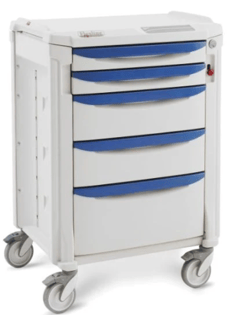
The benefits of a mobile medical cart depend heavily on how well the cart fits the work being performed. A cart that lacks the right storage, takes up too much room, or makes frequently used supplies difficult to access can create new inefficiencies instead of solving them.
Metro Flexline medical carts support different healthcare workflows through a configurable cart platform. Multiple cart sizes, drawer configurations, accessories, and storage options allow facilities to configure carts for medication management, treatments, bedside procedures, supply organization, and other clinical applications.
The goal is to give staff a cart that fits the work they actually perform. Depending on the application, that might mean prioritizing secure storage, adding a larger work surface, organizing supplies by procedure, or incorporating accessories for specific equipment.
Whether a facility needs a cart for medication management, treatment supplies, bedside procedures, isolation equipment, or general supply organization, Flexline can be configured to match the application.
Partner with CME Corp for Metro Medical Carts
CME Corp’s expert account managers can help you configure Metro mobile medical carts to support your unique point-of-care needs, mobile storage, and other clinical workflows. From recommending features and accessories to coordinating warehousing, delivery, and installation, CME is your one-stop partner for healthcare equipment by Metro.
About Metro: For over 95 years, Metro has been a leading manufacturer of storage and transport equipment. From innovative wire and polymer shelving to a diverse range of medical carts, Metro puts space to work in healthcare facilities everywhere.
About CME: CME Corp is the nation’s premier specialty distributor of healthcare, laboratory, and imaging equipment. We partner with over 2,000 manufacturers to offer more than 2 million products. In addition to an extensive product portfolio, we also offer project management, CAD-based layout, design and 3d modeling, warehousing, assembly, staging, consolidated, need-by-date direct-to-site delivery, and biomedical and technical services, all staffed by CME employees. Our mission, to help healthcare facilities nationwide reduce the cost of the equipment they purchase, make their equipment acquisition, delivery, installation, and maintenance processes more efficient, and help them seamlessly launch, renovate, or expand on schedule, is supported by service locations strategically located across the country.